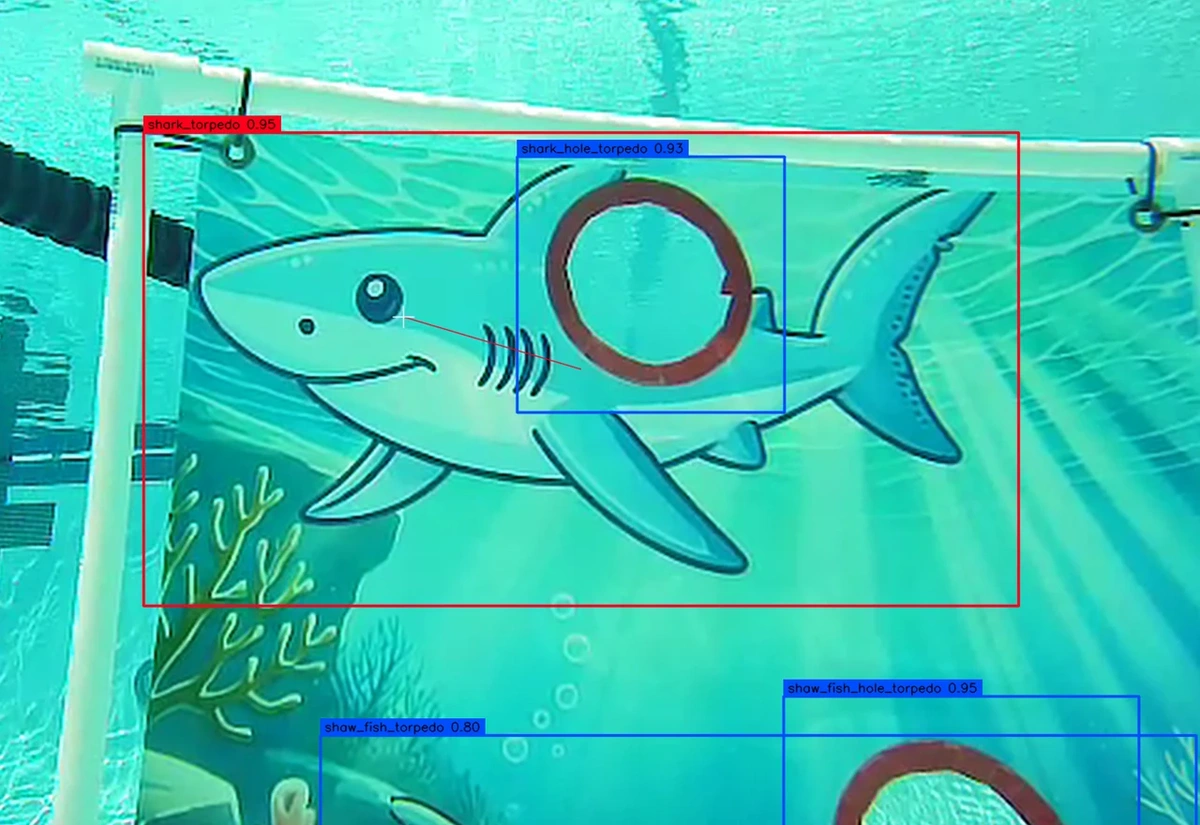
Mongla (মোংলা) is named for the port on the Pasur river, the gateway to the Sundarbans. It is the autonomous software architecture I have been writing independently since April 2026. The control board and its firmware are Rakibul Islam’s work; the interfaces between those responsibilities matter.
The design is for untethered autonomy. Ordinary Wi-Fi and GNSS are not dependable through-water links, so a mission cannot assume continuous positioning or teleoperation. Tethers and acoustic systems are different engineering options, not things that cease to exist underwater. Mongla’s software has to decide what it can do with the observations and links actually available—and refuse when they are insufficient.
- 500 Hz
- control loop, on a board core nothing else may interrupt
- 30 + 30 Hz
- two detector workers held their requested rates in a sharing bench
- 3 Hz
- XFeat alongside those workers; one repeated input frame
- 4,742
- passing tests reported at an archived checkpoint, not field validation
- 0 dives
- this independent platform has no water trials
Accelerator figures: 2026-11-19, 15 s per condition, inference calls rather than live ROS/camera throughput. Board and archived test figures have separate scopes.
The zero limits what I can claim; it does not certify the other figures. Each number still needs its own method and conditions. An older performance comparison in the project’s own ledger has already been cautioned or retracted, which is why the headline here is a smaller, dated claim.
Where it learned
Mongla began as the autonomy software for a university AUV programme, BRACU Duburi, where I led vision and then engineering. It ran on that programme’s vehicles. The vehicles, the team and the name stayed there; the software and everything it had been taught came with me.
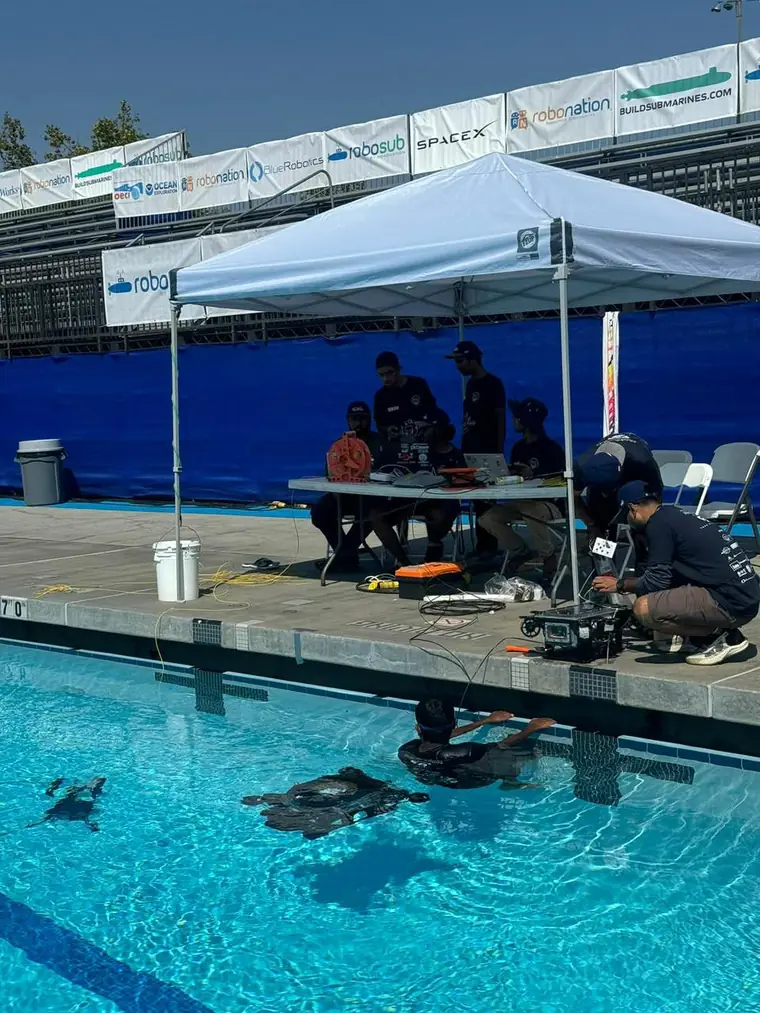
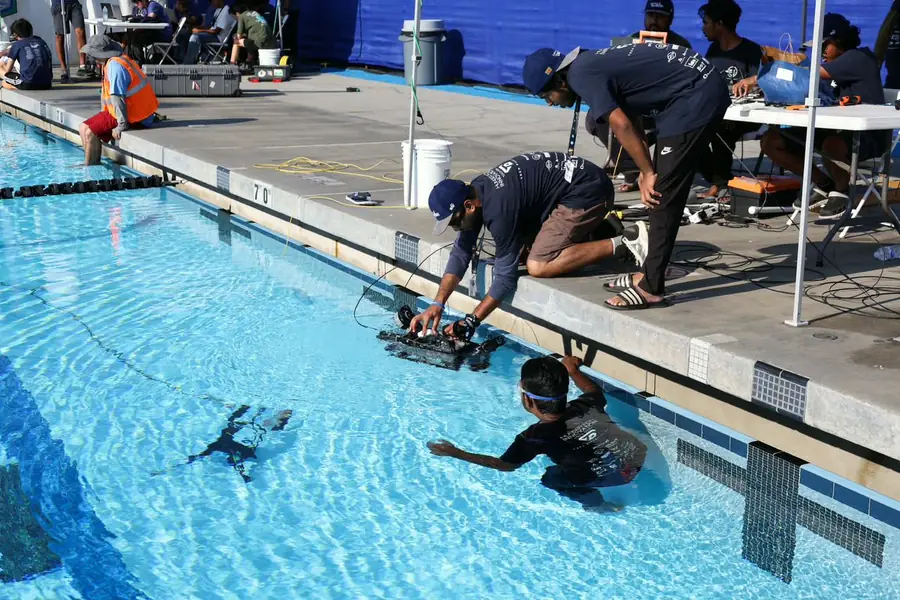
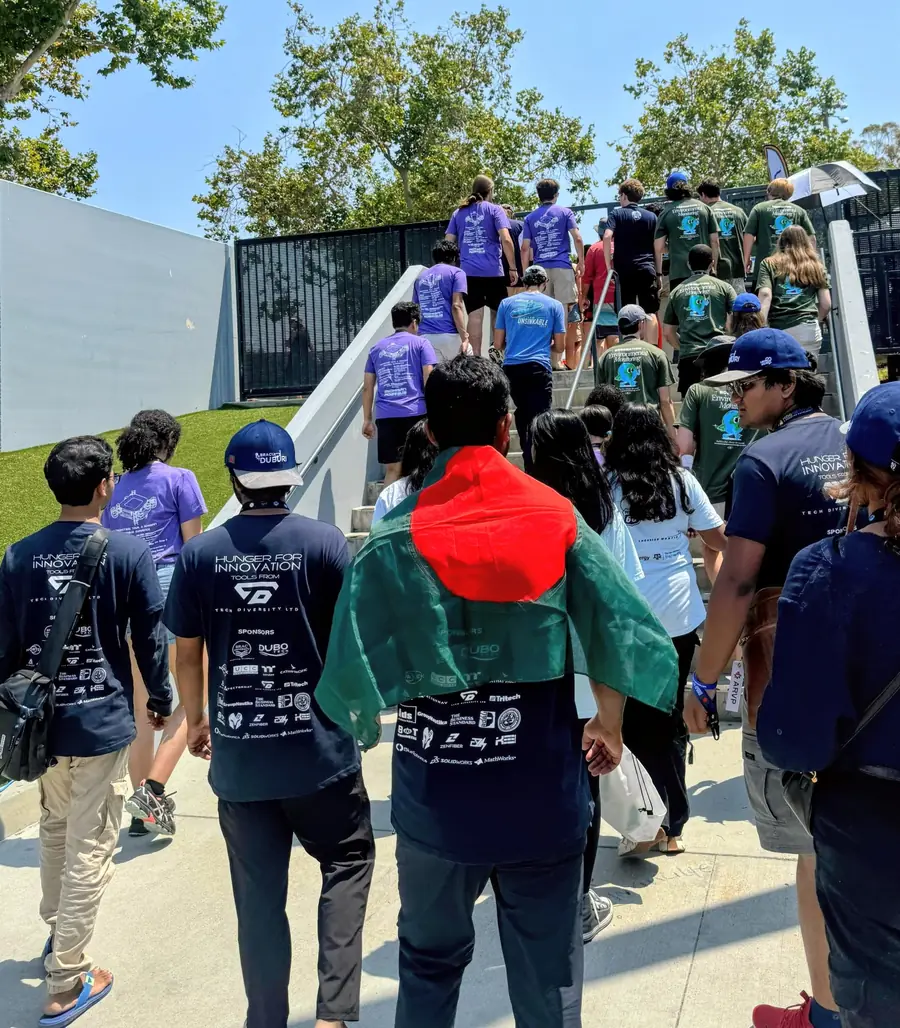
RoboSub photos from the university programme's campaigns.
| 2025 | 2026 | |
|---|---|---|
| final placing | 8th of 58 | 8th of 58 |
| best round | 4,083 (semi-final 1) | 6,234 (semi-final 2) |
| finals wild card | 4,250 | 6,500 |
| my role | vision sub-team lead | engineering lead |
Read round by round out of RoboNation’s published score sheets by a script, never typed in. Best round up 53 % year on year, and both years short of the finals line. The 2025 vehicle worked, and it had a ceiling: its control ran at 20 Hz, steering a box we weren’t allowed inside. That ceiling is the reason Mongla exists.
The fast loop lives where it belongs
A companion computer can’t hold an attitude. It sits on the far side of a cable, answering at whatever rate it can manage, and sometimes a neural net makes it late. So the reflexes live on a control board (an ESP32 with firmware called Hengla, written by Rakibul Islam), at 500 Hz on a core nothing else may touch. The Raspberry Pi 5, with a Hailo-8 accelerator, does nothing but think. They meet over one USB-C cable speaking MAVLink 2, and exactly one node is allowed to talk to the board.
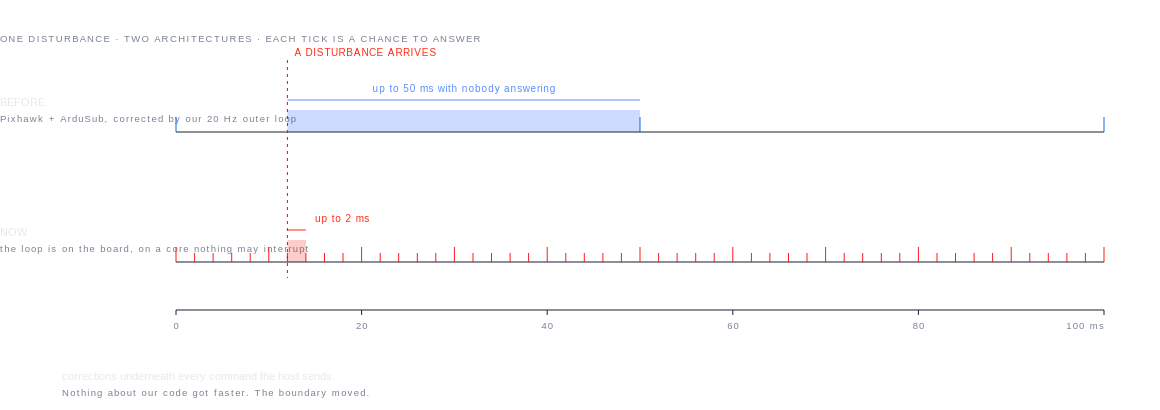
The proof of the split is a reading, not a diagram: when vision spikes, control doesn’t. The project’s own phrase for it is control costs vision nothing, measured as unchanged control-loop jitter under full vision load.
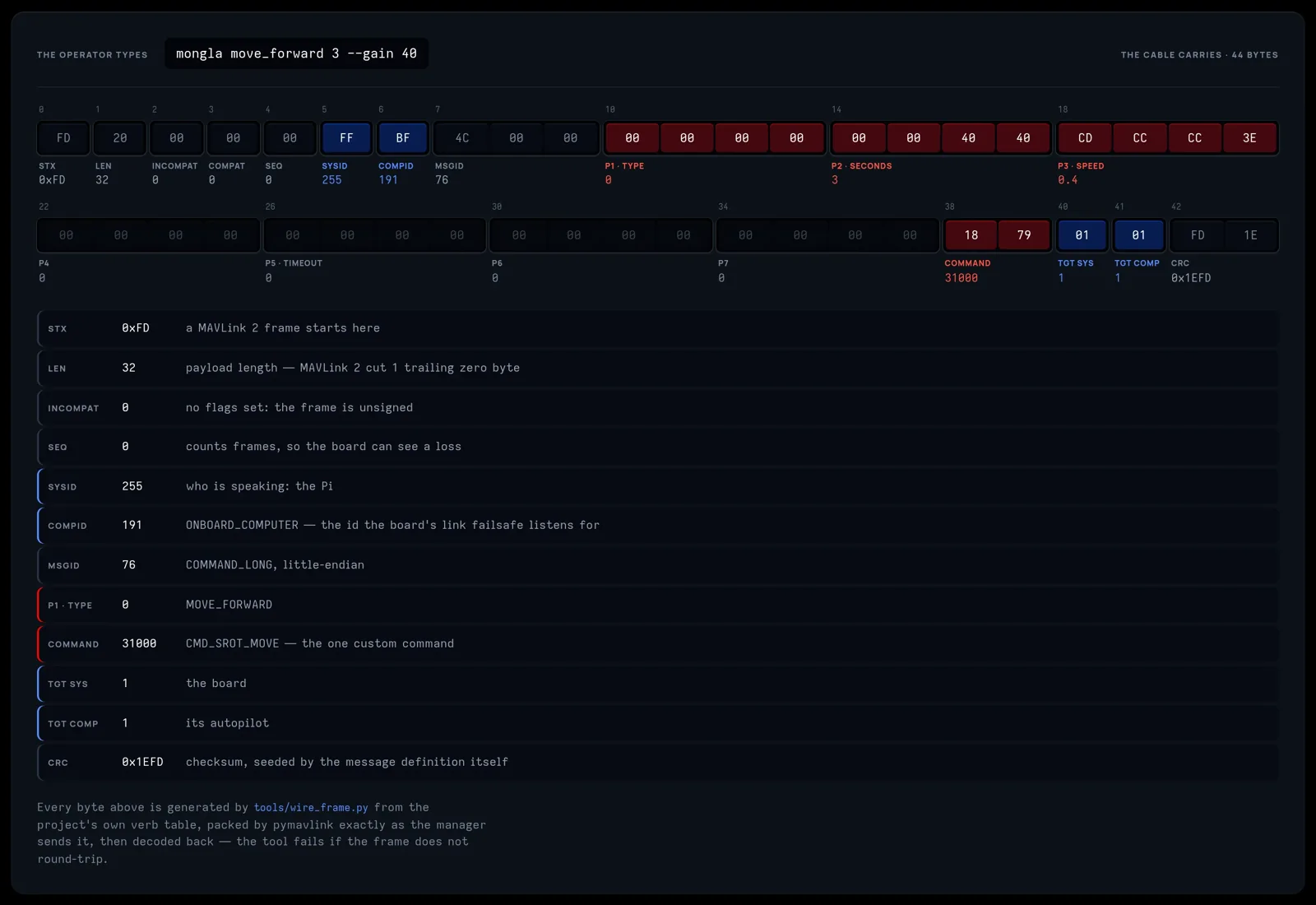
What crosses the cable is almost nothing. The whole of move_forward 3 --gain 40, the most ordinary thing the vehicle is ever asked to do, is 44 bytes: an envelope, then a type, a duration and a speed. No thrust, no motor, no angle. Which thrusters spin and how the hull holds heading for those three seconds is the board’s business. The Pi only said what it wanted.
A controller is not clever. It is patient, five hundred times a second.
702 millimetres of argument
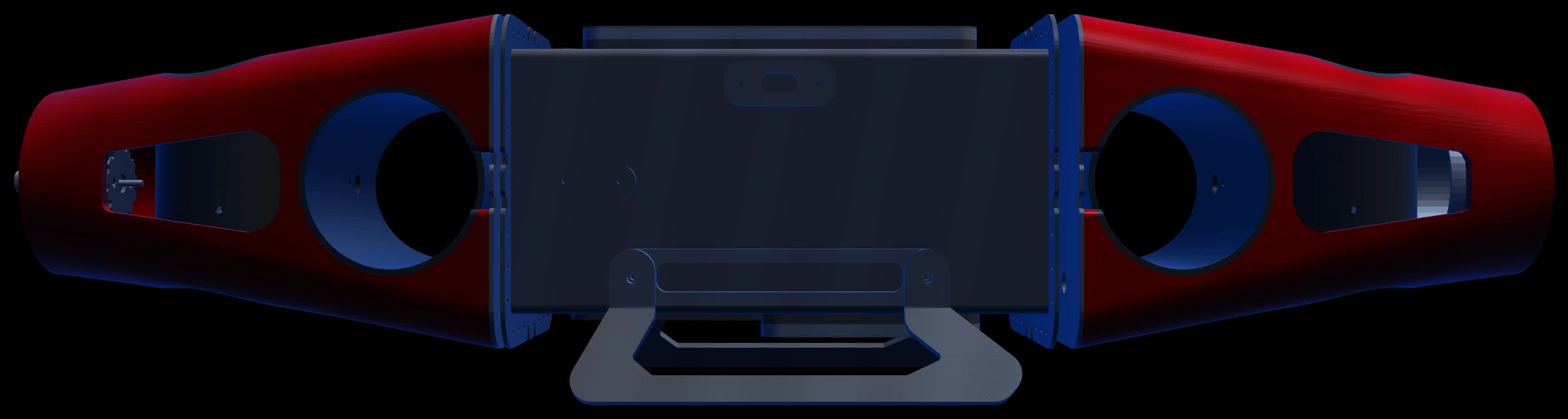
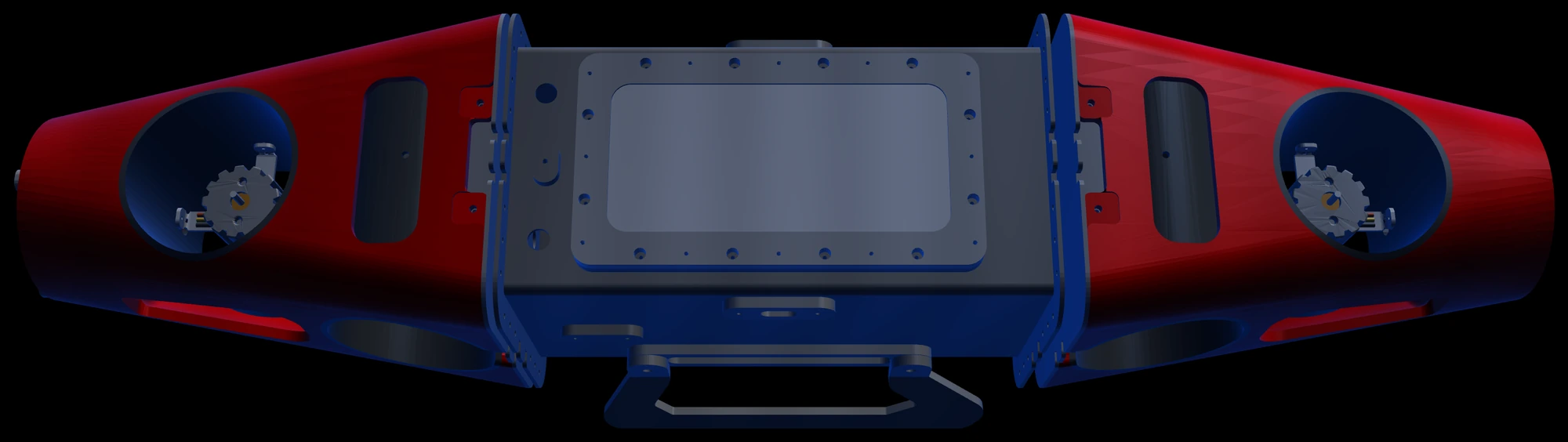
Rendered from the CAD mesh itself, not a photograph and not an artist's impression.
The archived CAD report gives bounds of 702.0 × 176.1 × 172.1 mm, a fineness ratio of 3.99 and 3.310 L of modelled dry volume. These are geometry values, not a validated displacement, buoyancy or drag result for a finished vehicle. The design places five thrusters on the centreplane: two lateral, two vertical and one axial. It plans sway/yaw, heave/pitch and forward thrust, with no dedicated roll actuator. Passive stability and the matching mixer still need validation; the archived record also flags an older eight-thruster mixer as a design/integration mismatch.
The observatory’s Mongla miniature illustrates capture, inference and control rather than pretending this unfinished hull is a built vehicle. The CAD views remain here as design context.
Everything down here fights you
| the medium does this | so this breaks | evidence and boundary |
|---|---|---|
| absorbs red first | colour thresholds, contrast tricks | 17 preprocessing configs, never once positive |
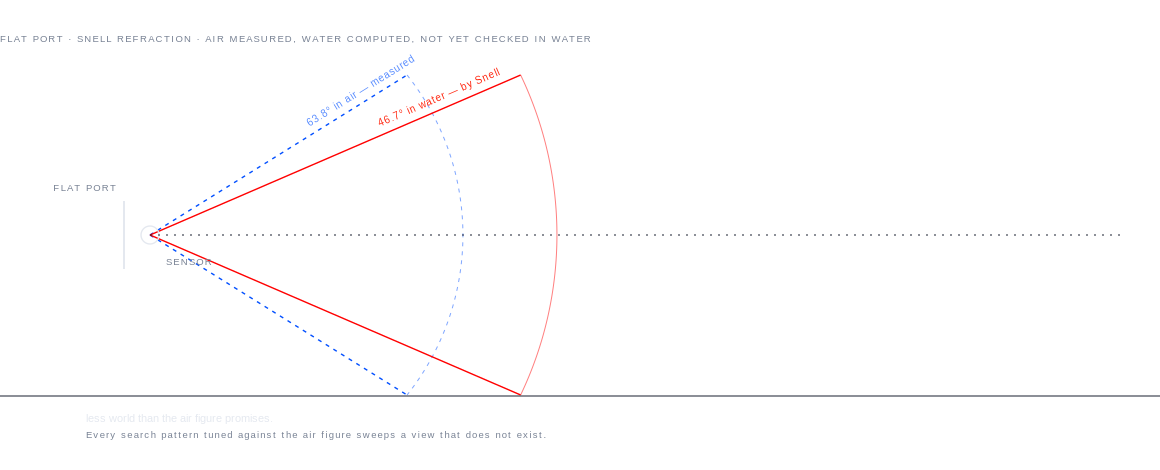
| bends light at the port glass | any angle taken in air | 63.8° in air → 46.7° in water, by Snell |
| strongly attenuates ordinary Wi-Fi/GNSS signals | assumptions of continuous radio positioning and teleoperation | the design cannot depend on that link; no RF-propagation experiment is claimed here |
| moves while you decide | position held by dead reckoning | simulated 0.12 m/s cross-current case: 1.374 m drift in 40 s, not an in-water measurement |
| hides what you were tracking | detectors that assume continuity | 71 real detection gaps, catalogued |
It sees, and it knows how it knows
An earlier version of this page quoted 53.9 Hz through the ROS graph and 18.0 ms “photon to detection.” The ledger explicitly cautions those B-61 rows: the HEF path supplied BGR to a model expecting RGB, and the record says to re-take the measurements before quoting. Standalone inference was subsequently re-measured; that does not turn the old graph figure into a current, matched end-to-end result. A later matched ROS probe also retracts the claim that the graph itself cost 45% of throughput. I do not keep those earlier numbers as validated headlines.
The accelerator claim used here is narrower. On 19 November 2026, hailo_share.py ran the shipped forward and downward detectors plus XFeat through one Hailo-8 VDevice. Each condition lasted 15 s and reused one real downward image. These are inference-call rates, not fresh camera frames, a ROS throughput result or an accuracy evaluation.
| Requested workers | Reported rates, Hz | What the condition establishes |
|---|---|---|
| forward 30; downward 60; no XFeat | forward 30.1; downward 44.9 | the detector pair already saturates before the requested downward rate |
| forward 30; downward 60; XFeat 3 | forward 30.1; downward 42.6; XFeat 3.1 | fails that original sharing budget; the extra work costs the saturated stream rate |
| forward 30; downward 30; XFeat 3 | forward 30.1; downward 30.1; XFeat 3.1 | holds the revised requested rates in this short, repeated-frame bench |
The failed first condition stays in the record. Reducing the requested workload is a second experiment, not re-scoring the first as a pass. The pinned benchmark and its same-day correction also separate where the contention occurs: a 12 s stage probe reports downward total-call medians of 13.94 ms alone and 23.09 ms paired, while the chip-stage medians grow from 13.49 to 22.60 ms. That points to accelerator contention under those conditions, rather than the earlier unmeasured guess that host work owned the queue. Medians from separate columns are not an exact additive per-frame budget.
The camera-queue result is another experiment again: 396.1 to 16.9 ms of age relative to the kernel’s timestamp in a controlled consumer-stall benchmark. It does not measure the same boundary as an inference call. That distinction, and the later timestamp bugs, are in the frame-age problem.
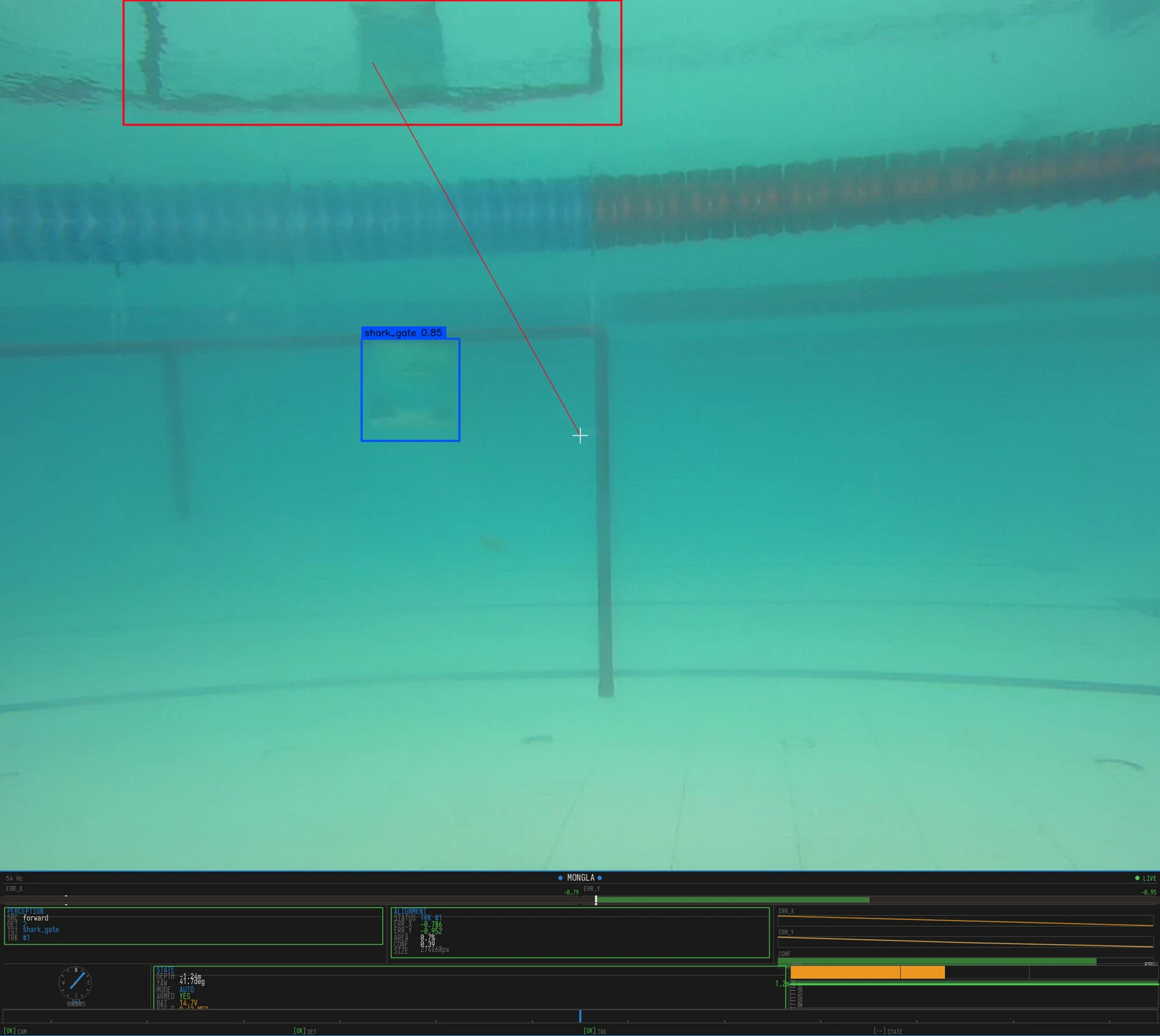
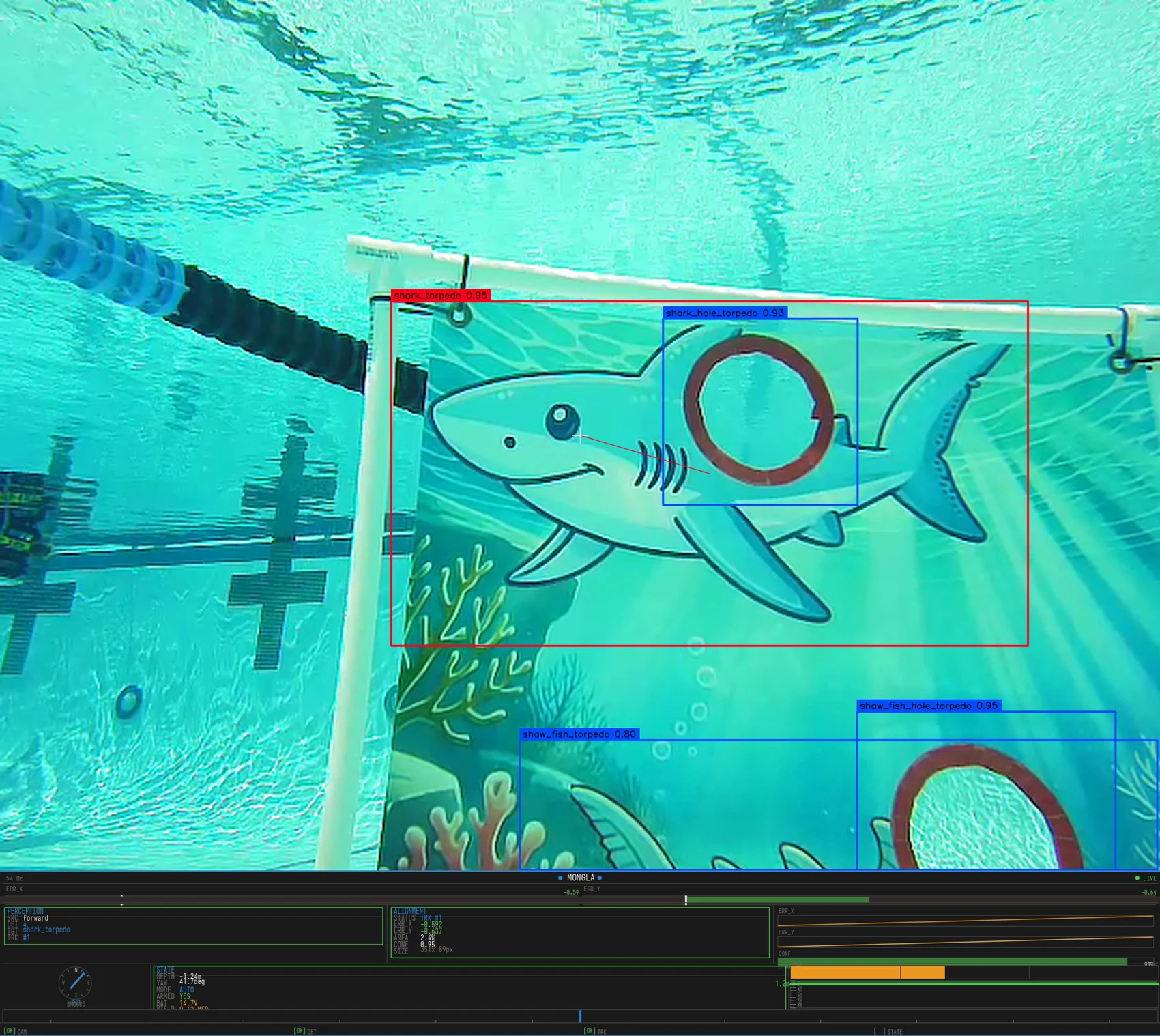
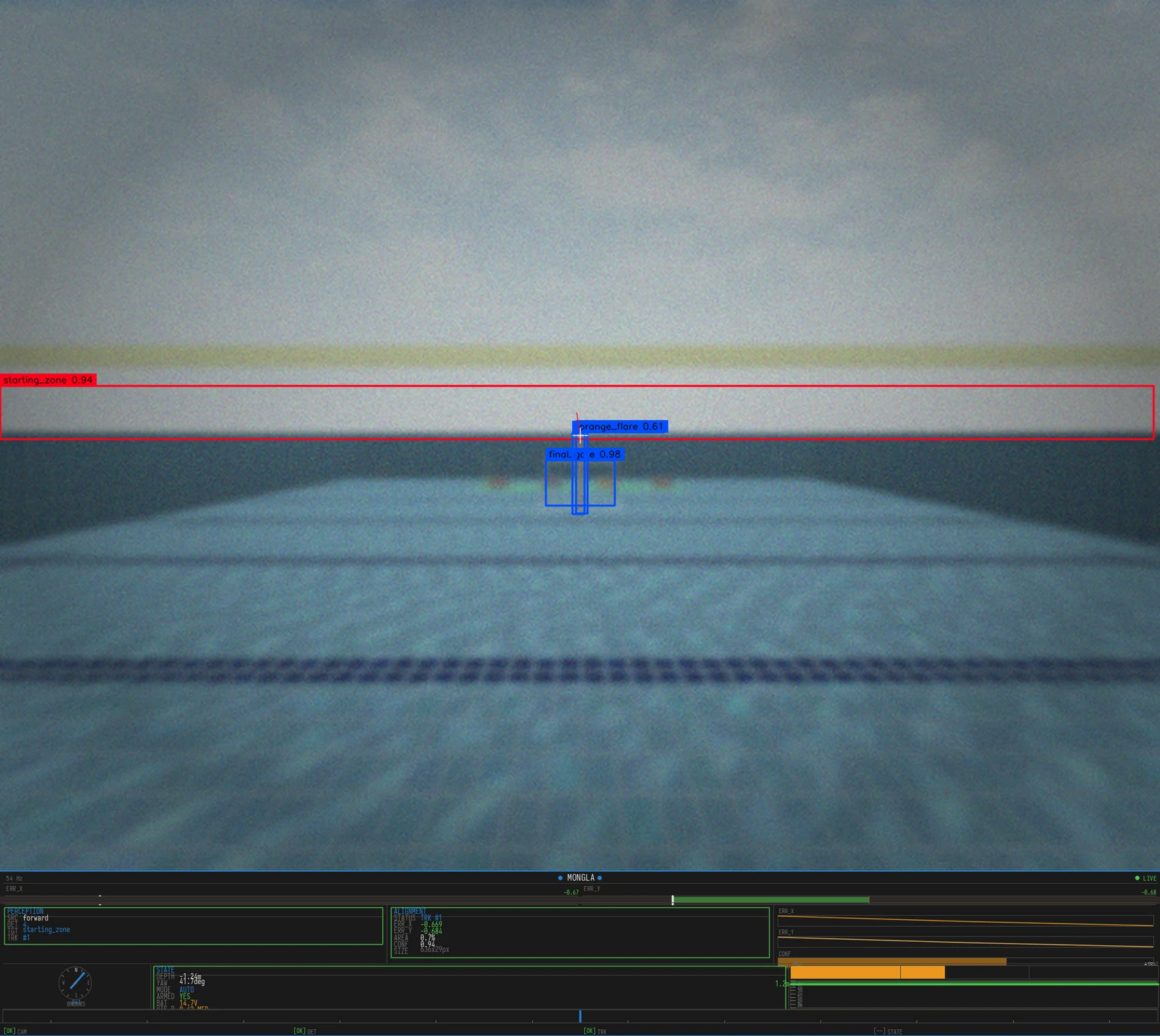
When the detector blinks, a lock ladder coasts the target through the gap, rung by rung, each rung’s timeout sized against those 71 real dropouts (p50 0.155 s, p90 0.651 s, worst 4.00 s) rather than a guessed constant. One clip held its target through 175 frames with no detection at all, because an anchor matched image structure instead of asking the network again. And the ladder ends in a refusal, not an invention: LOST is an honest answer. That’s tracking without detection.
A downward camera became a candidate velocity source: three 30 cm manual slides in air gave at most 1.09 cm distance-magnitude error. That is not a general vector-velocity accuracy figure or an underwater validation. A right-invariant EKF fuses observations with depth and heading, and replays late measurements at the instant they describe instead of when they arrive. The measurements and their limits are in turning a camera into a sensor.
The results it had to take back
The ledger holds 126 entries. Eighteen of them say, in their own title, that they took an earlier result back. Ten more measured an idea and the answer was to leave it off. They stay in the same file as the ones that stand.
- Image enhancement made detection better. Gate detected in 30.4 % of frames, and 1.2 % with enhancement on. Seventeen configurations, four props, three venues. Never once positive.
- Thruster health was verified. 958 of 958 ESC frames read exactly 0, with nothing plugged in. The check counted messages arriving, and messages arrive whether or not a motor exists.
- The depth loop works. It had never once run closed. When it did, in simulation, it flew to +20 metres: the sign flip.
A capability map that hides the blocked rows is marketing.
A mission should read like an instruction
Missions are Python. Twenty-three verbs, two of them vision primitives. The vision verbs never raise: they return how and where they finished (ALIGNED, LOST, TIMEOUT, DRIFTED…), so a mission branches on reality instead of an exception. The most important line in the example mission is a comment: never read x_px before checking saw_target. A result that’s absent must never be mistaken for a result that’s zero.
What stands between this and water
The honest list, from the project’s own roadmap: the board’s automatic mode has never held depth in water; thruster health can’t yet tell eight healthy motors from none; there’s no move-by-distance primitive, so no such verb (a timed move is all there is, never a faked metre); the velocity estimate has nowhere on the board to go yet; the competition radio can’t reach through an aluminium hull. None of it is hidden.
The essays from the notebook go deeper, one problem each: the 71 transposes, the canary that was already dead, the bank that ran the backbone five times, round 7, the anchor that took a second photograph, the engine room. The simulator it rehearses in has its own note.
I left on principle, and I’m building this on hope rather than optimism. Hope is the decision to keep working on the better version of a thing while the current version is still broken.