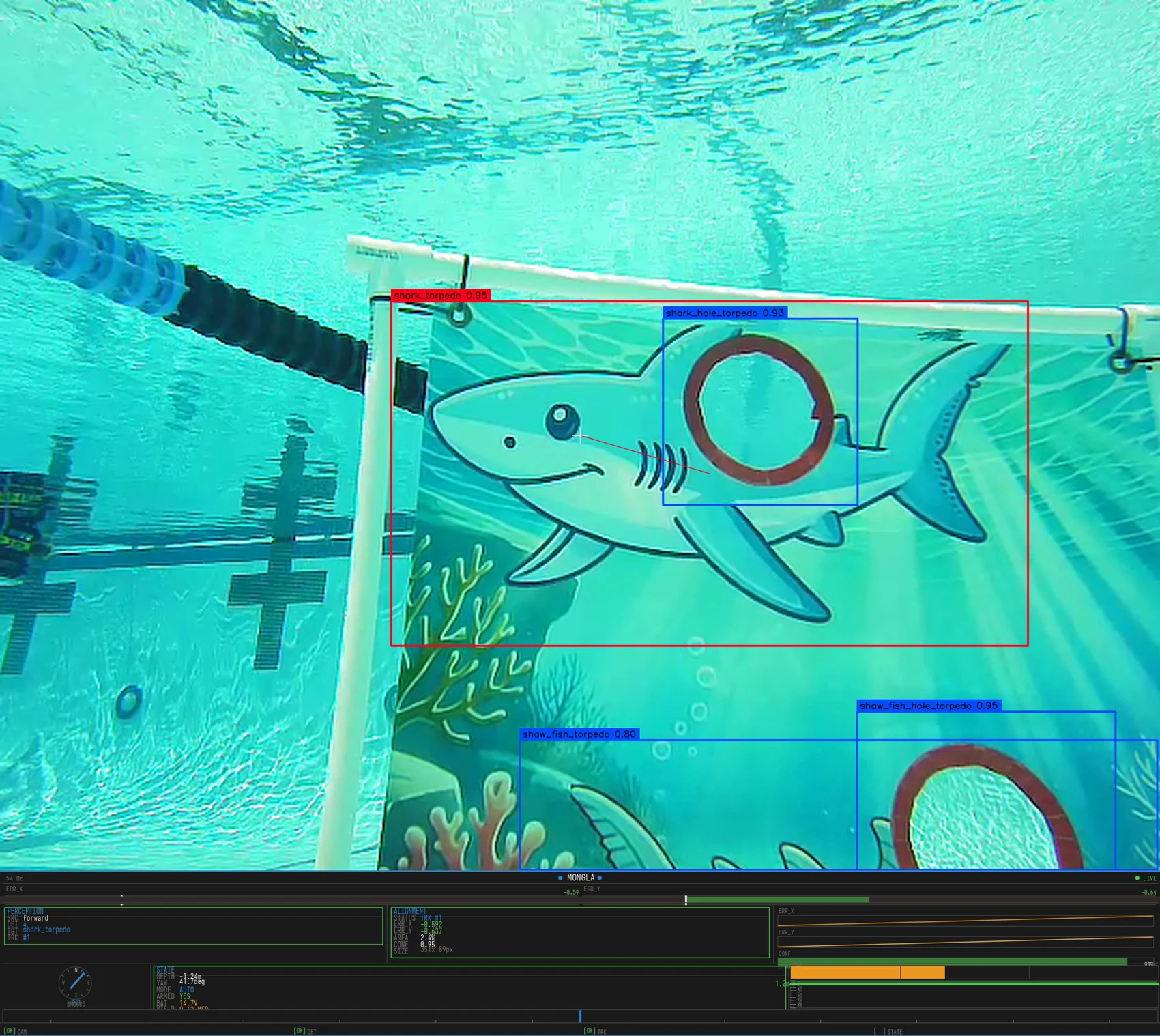
The guard read not self._anchor.has_reference. The anchor took a reference when it first saw the target and then kept comparing against that photograph. On the archived torpedo clips, the match weakened as the view changed:
A fresh reference could recover stronger matches without changing the descriptor network. That suggested a useful question: was the apparent model limit actually a limit of the views I allowed it to remember?
Several photographs, one feature backend
CheckpointBank composes the existing Anchor rather than inventing another feature matcher. References keep their image features and geometry; the bank decides which to query, retain and replace. Its early five-slot capacity came from a prototype, not from a measured optimum.
The relevant variable is not merely reference age. A target can change scale, viewpoint or visible region as the vehicle approaches it. A distant full view may give few usable correspondences when a close crop fills the camera. Several suitable references can cover that change, provided that searching them stays affordable and that an incorrect view does not become trusted memory.
This is also why an inlier count needs a picture beside it. A high count can describe background structure rather than the intended prop. A homography can be consistent with a wrong region. I need to see the projected quadrilateral and surviving correspondences, not just the largest number in a table.
A table of inlier counts says a match is consistent. It does not say what was matched.
The visual check found three defects
The audit tool overlaid the matched quadrilateral, warped annotations, correspondences and identity verdict on real footage. The close-range torpedo views were the revealing ones: the board filled the image, yet the bank refused them at seven or eight inliers because it had not acquired a suitable reference.
The source audit found three separate admission problems:
- The confidence floor refused most candidate views.
CONF_FLOOR = 0.60rejected 10 of 13 candidates on footage whose detector median was 0.49. The candidate-selection rule was excluding views before the geometric checks could help. - A thin bank was asked to judge its own bootstrap. Agreement was required before the bank had enough different references to establish it. This repeated a condition addressed in the older
dino_idea_v12.py: its rejection gate only became active once more than two templates existed. Porting the first-reference exception had missed the thin-bank case. - A healthy match prevented new coverage. The stale policy enrolled only after a match became bad. While the current view still matched, the bank failed to collect views it would need later. By the time a close view failed, the missing evidence could not be recovered from memory.
The corrections lowered the candidate floor to 0.25, delayed the agreement requirement until three references existed, and admitted useful candidates while capacity remained. The lower floor was not proof that weak detections were reliable identities: geometric agreement, the detector class and a separate 40-inlier recognition bar still had distinct jobs.
What changed on the recorded clip
The archived protocol enrolled on the first third of the clip and evaluated on the rest:
| Policy | References retained | Frames with an asserted identity | Median inliers |
|---|---|---|---|
| Original policy | 1 | 0% | 0 |
| Stale-only after the admission fixes | 5 | 26% | 23 |
| Stale plus scale coverage | 5 | 26% | 23 |
| Enrol while there is room | 11 | 33% | 27 |
That is completed replay evidence for a better admission policy on this clip. It is not a 33% field identity-accuracy score. Assertion frequency needs negative examples and independently labelled identity to establish false recognition; more assertions alone can be worse if they are wrong.
There was another correction worth keeping. An early scale-coverage comparison appeared to halve performance because the harness implemented the policy backwards: it skipped covered views instead of treating an uncovered scale as an additional reason to enrol. Once corrected, scale coverage was neutral on this clip. Its benefit in the production admission path remained unmeasured.
Memory can also preserve a mistake
A bank needs more than a generous capacity. An incorrect detection admitted as a reference can make later matching look self-consistent. Similar props of the same class can defeat a class check, and a strong background match can survive geometric filtering. The source’s thresholds are decision rules, not calibrated probabilities that remove those risks.
I therefore keep this result scoped to the reference-policy question. It does not establish underwater pose accuracy, solve long-term identity across every disappearance, or prove that a larger bank is always better. The later target-selection audit is a separate case where the proposed identity machinery did not justify its cost to the examined consumer.
What carries forward is more practical: render what the algorithm believes, give bootstrap and mature-memory states different rules, and evaluate admission changes against the future views they are meant to serve. Profiling that same bank found another concrete problem—recomputing the query features five times.