My first computer-vision program, November 2023, opened a webcam, ran OpenCV’s Haar cascade and drew a green box on my face. It felt like magic. Magic is a bad place to stop: a machine that finds faces has to be looking for something.

The detector is the Viola–Jones cascade (2001), as shipped in OpenCV’s haarcascade_frontalface_default.xml: 25 stages and 2,913 tiny comparisons. Each one asks whether one rectangle of pixels is brighter than the rectangle next to it. That’s the whole model. You can print it.
The first nine questions
Every 24 × 24 window in the image has to pass stage 0 before anything else looks at it. Stage 0 asks nine light-versus-dark questions:

No eyes, no skin, no idea what a person is. A face is whatever has its shadows in the right places. Most windows fail within these nine questions, which is why this ran in real time on 2001 hardware. You can step through the nine on my own 2023 face in the interactive face-detector bench; the bench computes each comparison on the real pixels.
How far can you tilt your head?
The face is rotated in 2° steps about its own centre, padded with flat grey so the detector can’t cheat on a mirrored copy. A hit only counts if it lands on the real face at a plausible size.
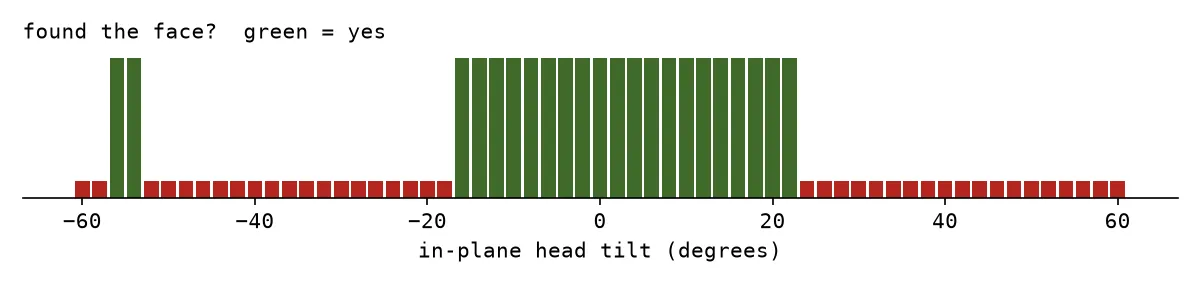
That’s a window of about 38°. It comes back for two frames near −55°, for reasons the cascade does not explain. A frontal face detector means it: tilt your head like a curious dog and you stop existing.
Faces in things
With the neighbour vote loosened from 5 to 3, the cascade ran over twelve images with no people in them: coffee, a rocket, gravel, grass, the Moon, the Hubble deep field, tissue under a microscope, a page of text.

It found 9 faces. Seven are on a tray of ancient Greek coins, which really do carry portrait heads. So the detector was right, and I was the one who assumed. The other two, a motion-blurred clock and a patch of gravel, are true pareidolia: the brain’s habit of seeing faces in sockets and clouds, reproduced in 2,913 rectangles.
Back to the bedroom
The same detector, run again on the original 2023 screenshot:
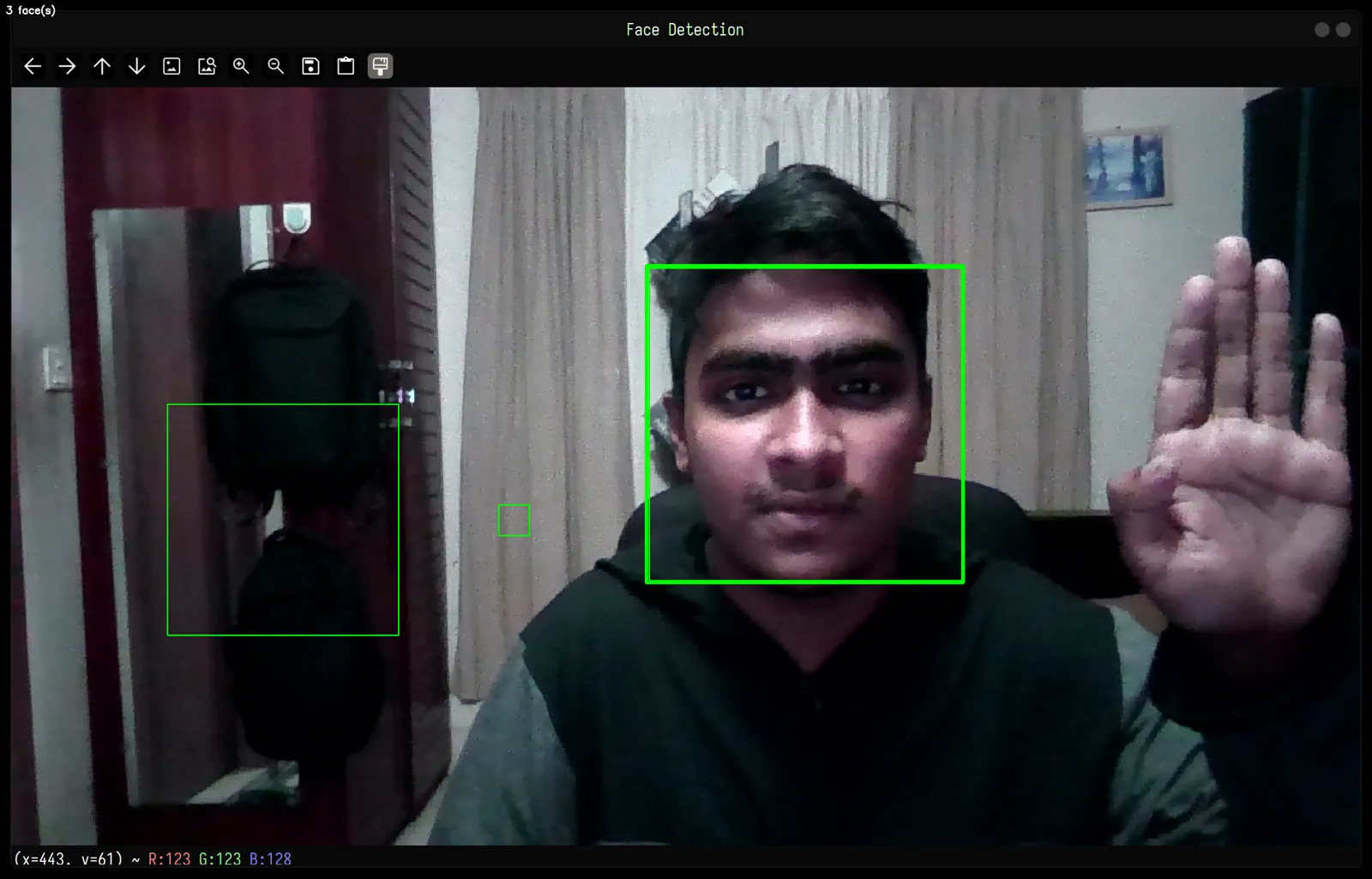
Fair disclosure: the new loop equalises the histogram first, which the 2023 one didn’t. That brings out shadows, including the backpacks’. Same model, slightly different question, very different furniture.
- 2,913
- rectangle comparisons in the whole model
- −16° … +22°
- head tilt it tolerates before you stop existing
- 7 of 9
- 'false' faces that were real faces on coins
Why it matters to me
Every detector I trained after this, on underwater vehicles and rovers, was a deeper and more opaque version of this one. This was the last time I could print the whole model, read it, and point at the exact rectangle that made the mistake.
The detector wasn’t wrong about the backpacks. It answered the question it was asked. Most vision bugs are a question asked badly.