Dristy is Bengali for sight. It’s open firmware and a host API for a Kendryte K210 camera module (a DFRobot SEN0305) that does vision on the camera itself, so a robot gets a compact answer over a serial line (“target at error_x, error_y”) instead of a video stream it has to decode.
A robot doesn’t see. It has a sensor that turns light into numbers, and a program that has to decide what those numbers mean before the motors move. Dristy is that program, running on the sensor.
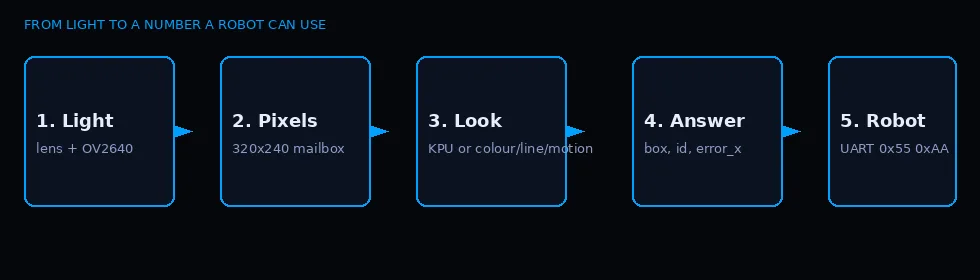
Why put the brain in the camera
A flight controller or a Raspberry Pi can run vision. Usually you shouldn’t make it. If the main computer does vision, it has to ingest JPEG or YUV at tens of frames a second, and a stall in OpenCV stalls attitude control: you end up debugging why your PID is late. If the camera does vision, it sends a few bytes (an id, x, y, a size), and the robot’s loop stays boring and fast. Dristy is the same idea as a GPS module: a specialist that speaks a short protocol.
It’s also the same idea as Mongla’s board split, at a smaller scale: keep the slow, heavy thinking away from the thing that has to be on time.
What it does, shown rather than claimed
Every LCD picture here was pulled off a live board over UART, from the device’s own 320 × 240 screen.
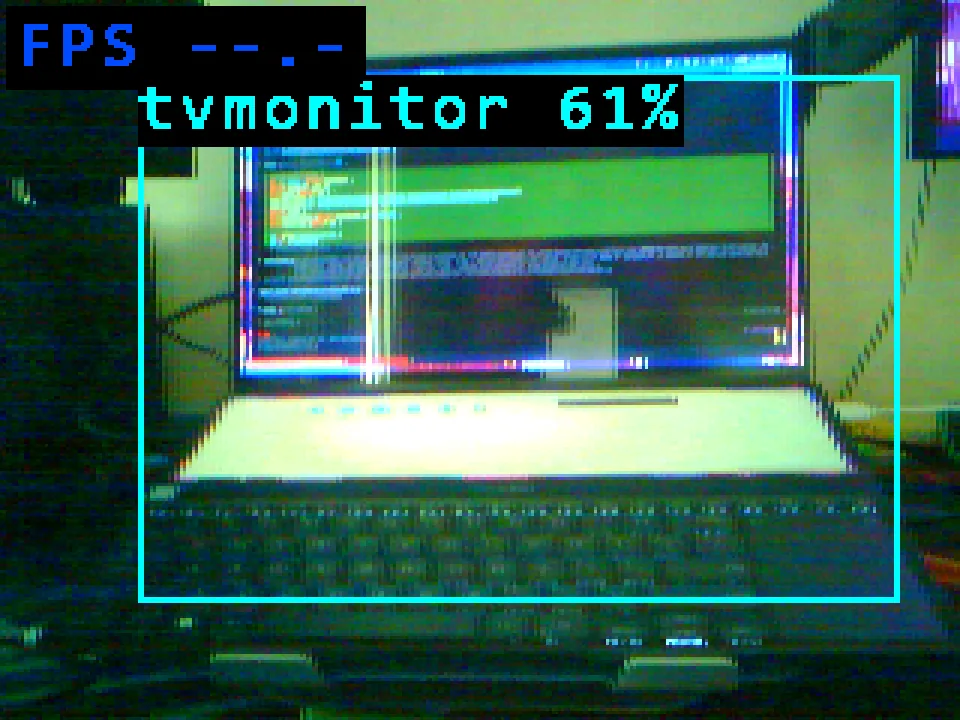
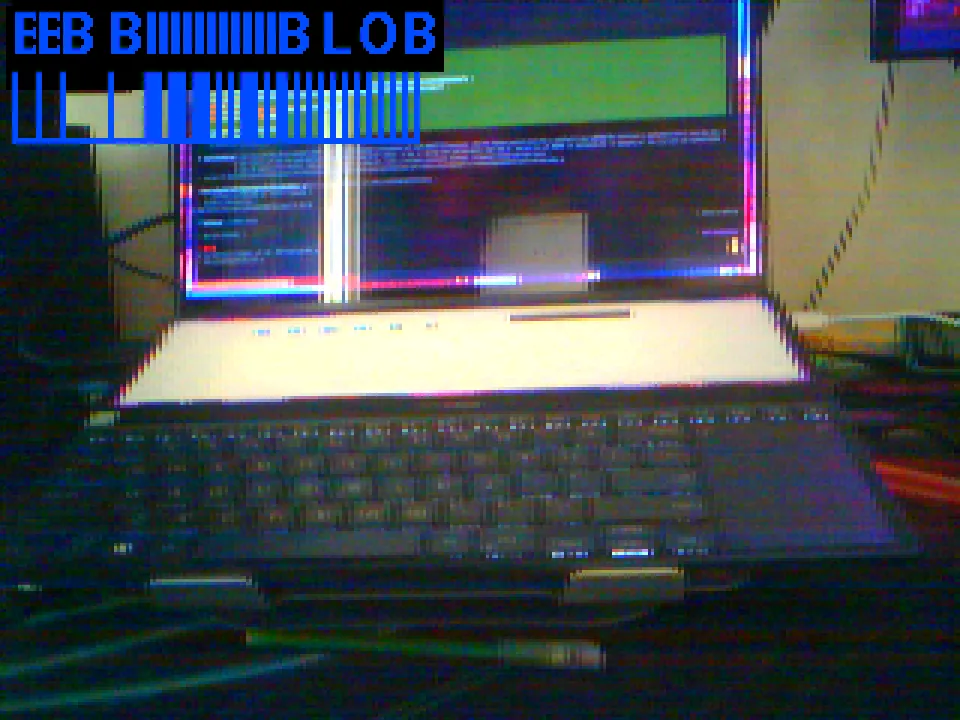
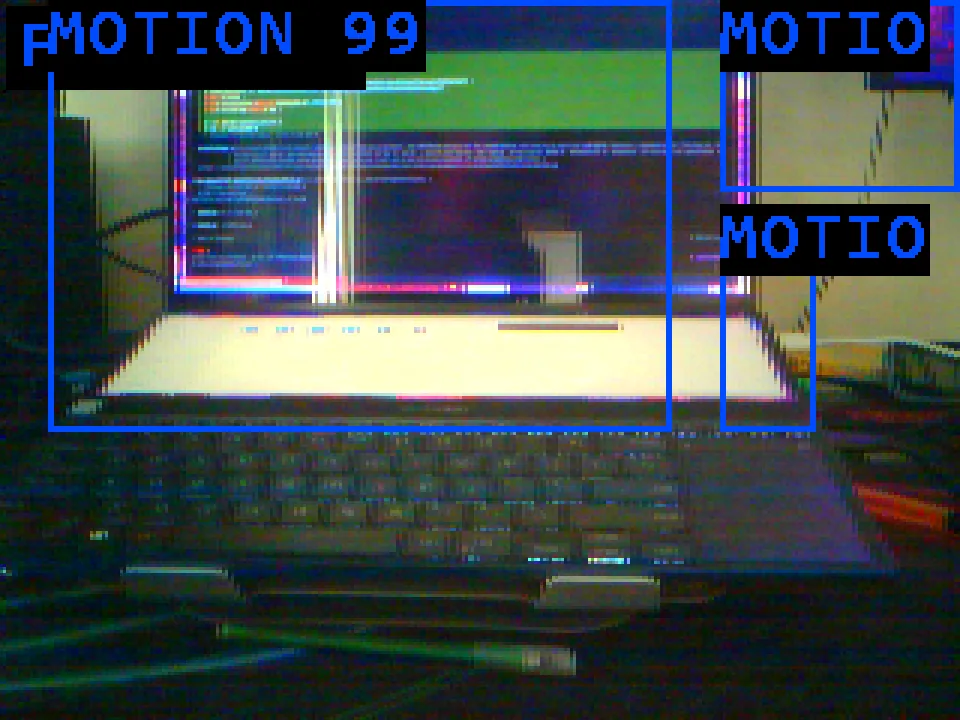
Captured on a DFRobot SEN0305 over UART, 19 Sep 2026.
The same firmware also reads QR codes, AprilTags and ArUco markers, follows a line by regression on a contrast strip, estimates optical flow, detects faces on the KPU, and runs a hybrid detect-and-track mode for a lock that survives a missed frame.
| job | mode | measured on the desk |
|---|---|---|
| VOC detect | DETECT | about 7 FPS when the net runs |
| colour | COLOUR_TRACK | 16 blobs, about 19 FPS |
| line | LINE_FOLLOW | line valid, about 20 FPS |
| motion | MOTION_DETECT | 55 %, then 99 in the shot above |
| tags, QR, face | those modes | handshake ok; zero hits until shown a marker or face |
Zeros there mean the scene had no tag or face in it, not that the mode is dead. The audit says which.
The budget is the architecture
The K210 has two 64-bit RISC-V cores, a convolution engine (the KPU), 8 MiB of SRAM, no Linux and no MMU. On a chip that small, where every buffer goes is the design.
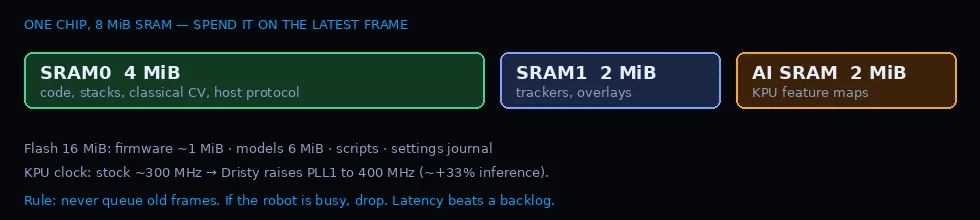
- 400 MHz
- PLL1 raised at boot: about +33 % KPU speed before any micro-optimisation
- 320 × 240
- one mailbox frame; the newest wins
- 0x55 0xAA
- the industry-common packet framing, so stock tools still work
One rule runs through all of it, the same one that runs through Mongla:
Keep the newest frame, throw the rest away. Dristy is a mailbox, not a queue.
A robot that steers on a picture from 200 ms ago is worse off than one that missed a frame. The camera preview and the neural net even share one camera lease, so opening the detector has to stop the preview first. That isn’t a bug; it’s the physics of one pipe.