A detector can return a correct box from the wrong moment. The counters tick, the picture looks plausible, and the control loop receives an observation that has been waiting in a queue. A vehicle moving at 0.5 m/s travels about 17 cm in a third of a second; that is a kinematic illustration of the cost, not a measured underwater run.
This investigation starts with one controlled camera-path benchmark, then follows what the later source record changed. The distinction between call duration, age relative to a kernel timestamp and physical sensor-to-actuator latency matters throughout.
What the tested queue actually held
The V4L2 streaming API distinguishes empty buffers queued for capture from filled buffers available to dequeue. Returning a filled buffer to the application does not by itself make that storage available for another capture: it has to be requeued. The kernel’s QBUF/DQBUF documentation describes that ownership exchange. It does not promise an unlimited backlog of recent images.
In the linked benchmark, a consumer stalled for 400 ms at a nominal 60 fps. The four waiting buffers had sequence numbers +1 to +4 relative to the previous frame: the beginning of the stall, not its end. Their reported ages were approximately 396, 380, 364 and 344 ms, measured against the kernel-provided timestamps.
Loading the diagram. It needs JavaScript; the text around it says the same thing in words.
Later sequence numbers were absent from that host queue. That observation does not establish that the sensor never exposed those images or identify every device-side drop stage. The report observed the pattern on Sonix and Fantech cameras; two devices do not establish every camera’s firmware and buffering behaviour.
On this capture path, draining the queue meant choosing the least-old retained frame—not recovering the recent frames that were missing from it.
Four policies, one stall
The same camera-path test compared four policies after the same 400 ms consumer stall, with ten repetitions per policy. These are ages relative to the kernel’s stamp, not direct measurements of photon exposure or thruster response:
B reduced the reported age by about 12% in this setup. C selected a newer frame but blocked the caller. D separated the reader from the slower consumer, returning buffers promptly while keeping a latest-frame slot. Under a separate 25 ms-work-per-tick consumer test, the report records 22.4 ms median / 31.95 ms p95, with the pump at 62.5 Hz and no sequence gaps observed in that run.
Those observations are not a guarantee that a reader thread can never be descheduled or drop a frame. The source also records a different buffer-count sweep with one dropped frame in roughly 400 at every setting. A mechanism can remove a particular source of backlog without making the whole system infallible.
A fast return is not a fresh image
Timing read() measures how long the call took. An already-filled old buffer can return quickly; waiting for a new observation can take longer while giving a younger image. Neither duration alone tells the consumer which event the pixels represent.
The benchmark therefore reads v4l2_buffer.timestamp through ioctl and compares it with the corresponding monotonic clock. The report describes that stamp as the frame-arrival boundary. It is not an independent photodiode measurement of exposure start, and timestamp meaning and clock domain still need checking on a different driver.
The empty-queue boundary matters too. If the consumer resumes at 20 ms but the model’s first new frame is at about 66.7 ms, plain reading must wait about 46.7 ms. It cannot invent an immediately available fresh frame. A latest-frame slot can instead return the preceding frame again; that is an old observation, not a new one. Frame identity and age must survive the interface.
The software path has its own boundaries
For a single-camera, no-contention run, the source reports these ages against the same kernel stamp:
| Observation boundary | Reported age (ms) |
|---|---|
| read returns | 14.56 |
| after cv_bridge encoding | 14.88 |
| after publish returns | 15.20 |
| at the subscriber | 16.96 |
These are reported boundary ages, not a physical photon-to-thrust timeline or an exact additive decomposition of every processing stage. Different camera modes, contention and detector configurations need their own measurements.
In the camera report’s later §19, the run identified as 72e1e83 used the forward camera with the downward camera paused for 60 s. It records 11.46 ms median image age and 27.25 ms median detection age at their subscribers. Those are another configuration again; they should not be spliced into the four-policy test or into a bare accelerator benchmark.
A timestamp can lie in two places
The first bug was at publication. camera_node stamped now() when publishing an image, so a frame that had queued appeared newly born. The source correction carries the kernel-derived observation time instead.
The second was downstream. The detector preserved the image header, but vision_state replaced its time with the arrival instant of the detection message. Freshness decay and frame-newness checks then measured time since arrival, hiding the pipeline’s age again.
These are not merely display defects. A consumer using age to decide whether to coast, reduce authority or accept a distinct observation needs the time of the observation—not the most recent function call that touched it. Dhara exposes the related velocity error: even a positive duration can name the wrong pair of events.
Copying can be the right ownership decision
The capture pump copies compressed bytes out of the reusable driver buffer; decoding happens when a consumer needs an image. Its immutable slot carries the payload, capture time and sequence together. Replacing the slot does not mean a consumer should suddenly decode bytes from a different frame under the old timestamp.
The source reports 13.1 µs for the byte copy versus 2,450.2 µs for JPEG decoding in that experiment. A zero-copy view saved only about 11.5 µs while requiring the driver buffer to remain pinned until the reader finished. Saving that copy was not automatically worth a more fragile lifetime contract or tying up capture storage.
The later report also changed its earlier capture-rate advice after moving decode out of the pump: with a 30 Hz consumer, requested capture settings from 30 to 210 Hz reduced reported age from 46.12 to 8.94 ms at similar CPU cost. That is evidence for that mode and implementation, not a promise that every sensor can reach the requested rate. Capture, decode and publish rates are separate knobs.
Freshness is not a finished verdict
An archived report below ends with “sensor is the limit” and full configured control authority. It records what that report printed; it does not establish a permanent limit for every later pipeline. Authority is a policy output under particular thresholds, not a navigation-accuracy measurement.
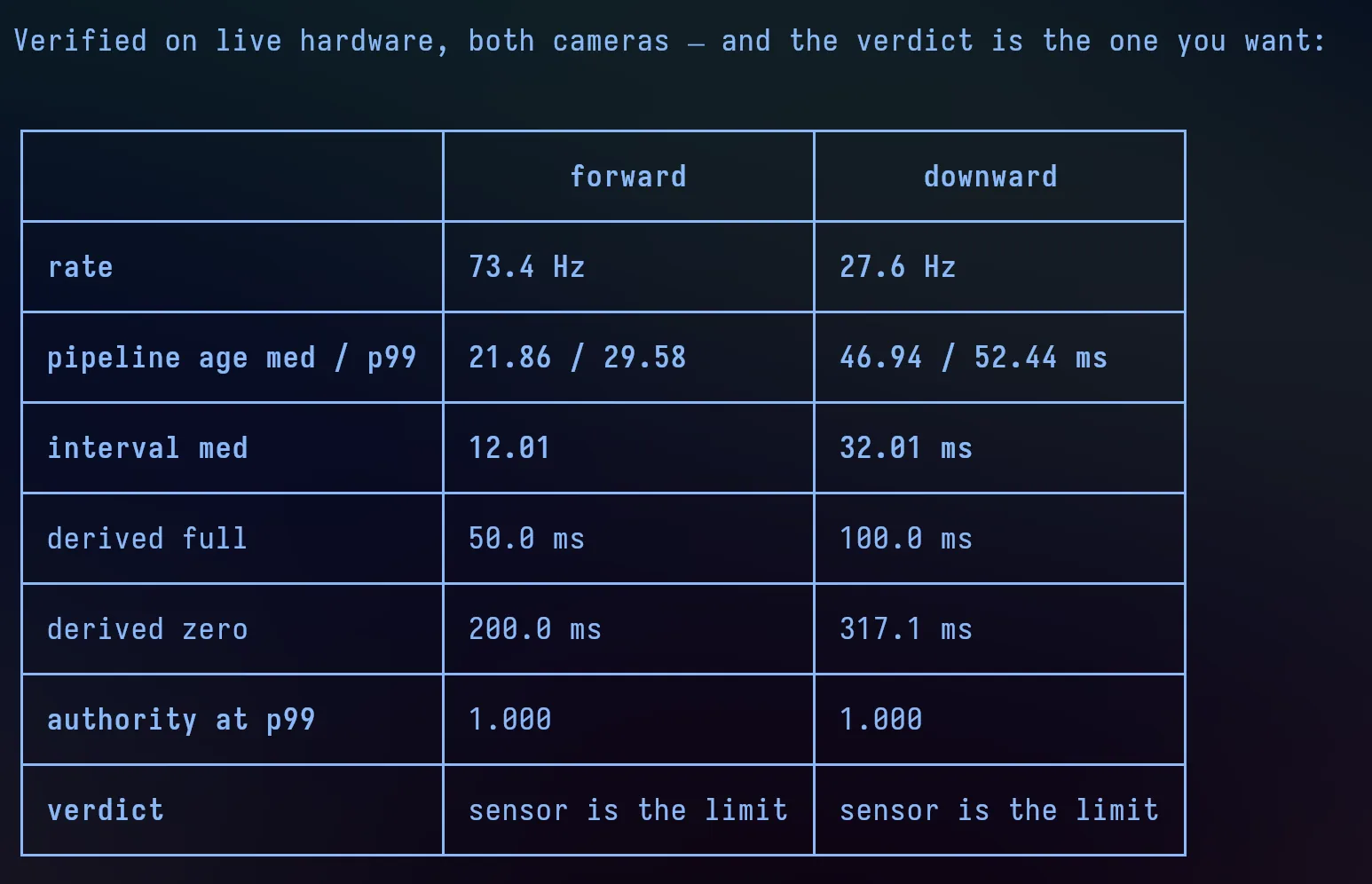
The old “18.0 ms photon to detection” budget illustration has been retired from this page. The primary ledger explicitly cautions that B-61 path after a BGR/RGB mismatch. The Mongla story now separates the dated accelerator-sharing bench, the failed workload condition and the later stage probe instead of chaining unmatched sessions into one attractive timeline.
The speed of light sucks.
The useful habit is to attach a boundary, clock, frame identity and configuration to a timing number. Dristy separates device-side results from streaming a whole image. The older bottle narration experiment shows why a correct description arriving late is still a different product.
Next: tracking without detection, for when the newest frame has nothing in it at all.