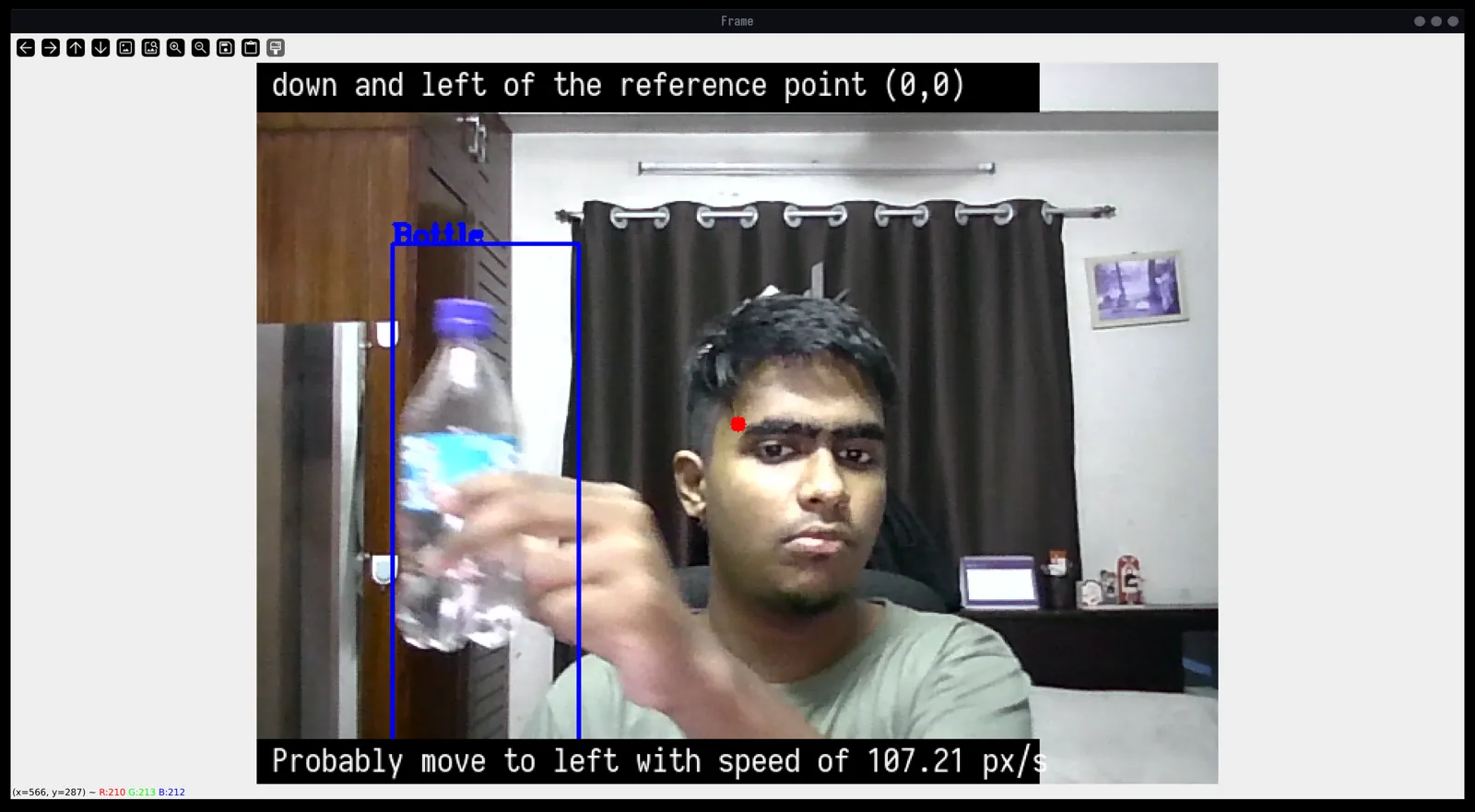
March 2024. I pointed YOLOv7 and a CSRT tracker at a water bottle and had the window narrate what it saw. Probably move to right with speed of 98.41 px/s. Two decimal places. Very confident.
It was this frame’s box centre minus the last one, divided by the time between them. Box centres jitter, so the narration jittered, and so did any “prediction” built on it. The rewrite asks two honest questions: how wrong was that, and how far ahead can anyone actually see? It answers twice: once in simulation, where the truth is known, and once on the real 2024 recording.
Three ways to guess the future
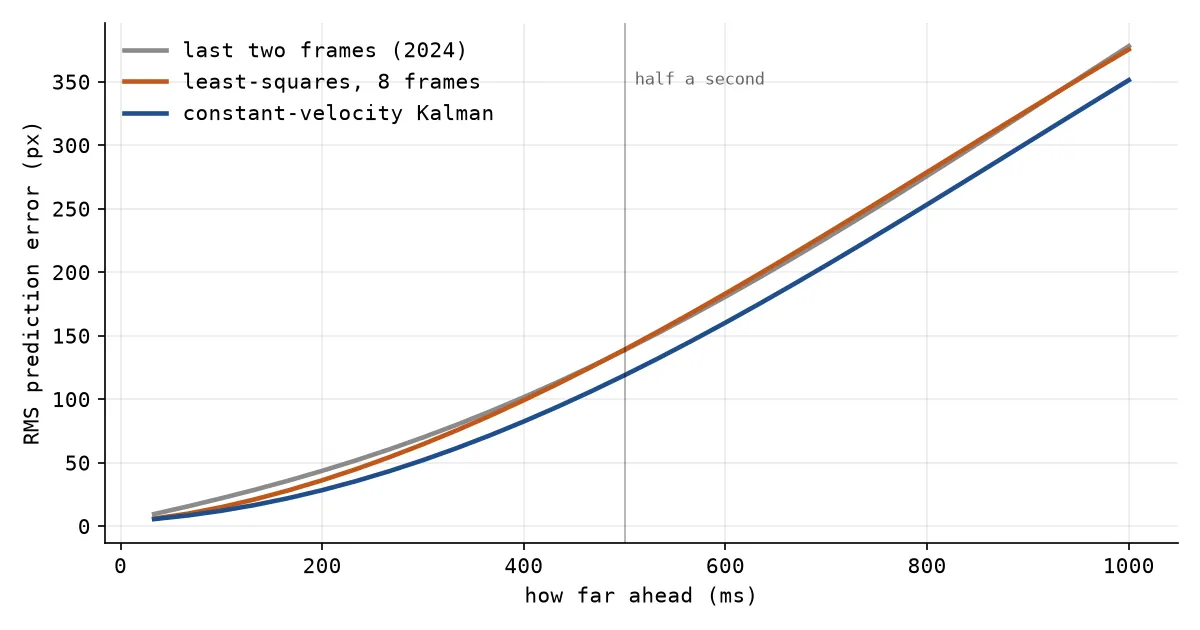
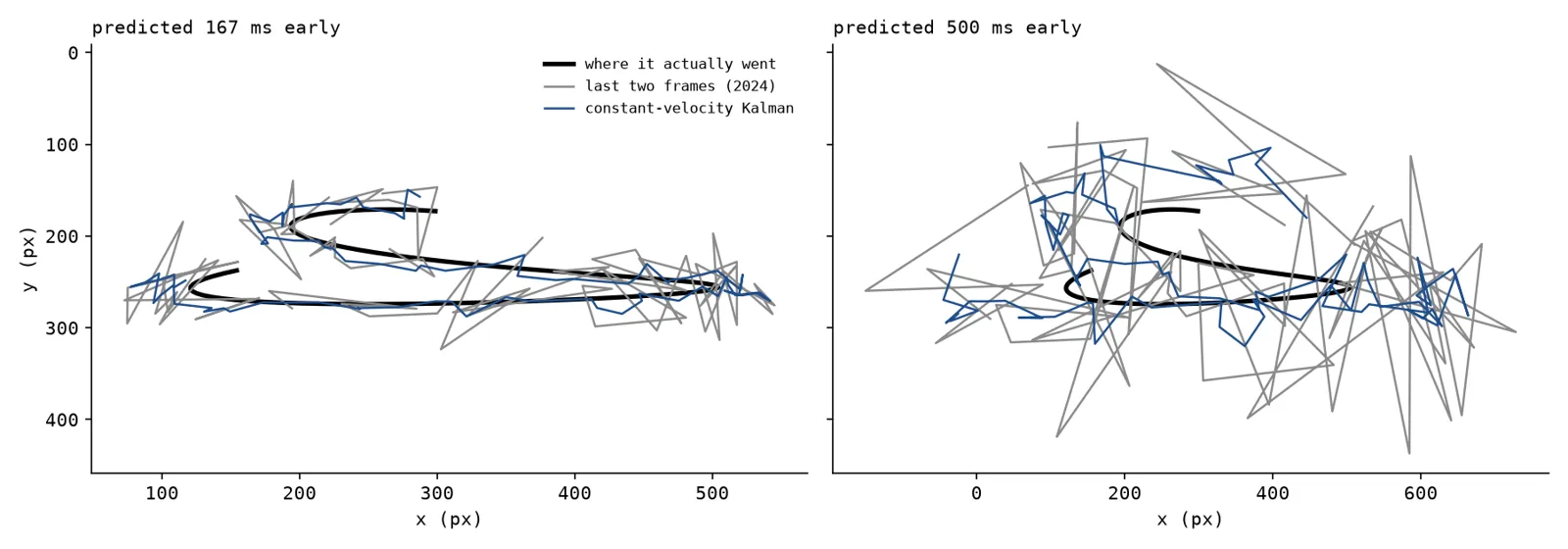
The motion is a hand waving a bottle: four slow sinusoids per axis at 30 fps. The tracker reports it with 3 px of jitter (about what CSRT gave me) and loses it on 5 % of frames. Three predictors guess where the bottle will be h frames later:
- Last two frames (2024): velocity is the difference of consecutive centres.
- Least squares over 8 frames: fit a line through recent centres, take its slope.
- Constant-velocity Kalman filter: its process noise tuned on a different trajectory, so it doesn’t get to study for the test.
| look-ahead | last two frames | least squares | Kalman |
|---|---|---|---|
| 33 ms | 9.5 px | 6.0 px | 5.5 px |
| 167 ms | 35.9 px | 28.2 px | 22.1 px |
| 333 ms | 79.8 px | 75.4 px | 61.4 px |
| 500 ms | 138.6 px | 139.1 px | 118.9 px |
| 1 s | 378.0 px | 375.4 px | 351.2 px |
Asking the real 2024 video
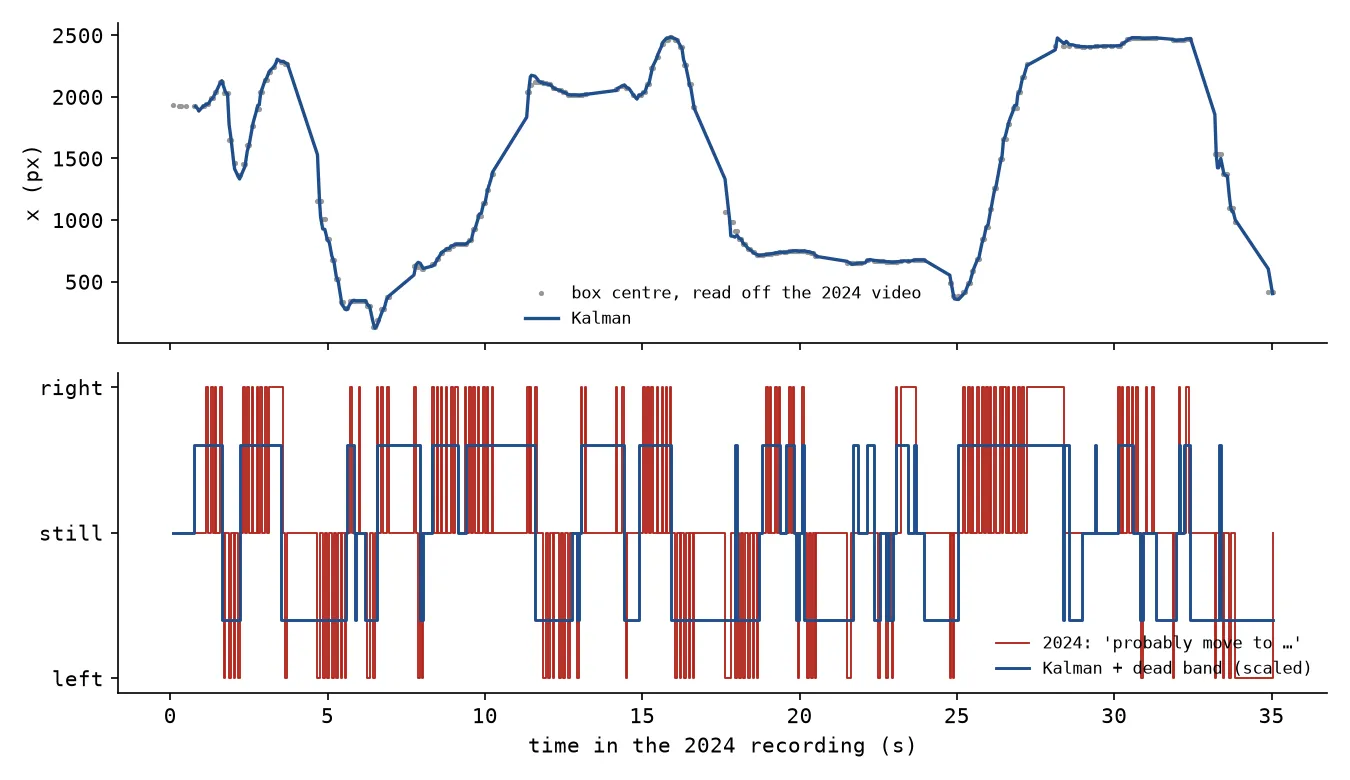
The 2024 recording draws CSRT’s box in pure blue, and nothing else in my room is that blue. So the bottle’s actual 2024 track can be read straight back off the pixels: 35 s at 30 Hz, box visible in 92 % of samples. Then the same filter runs over it.
- 17 %
- verdict flips the simulation predicted for the 2024 method
- 19 %
- flips actually measured on the 2024 recording
- 11 %
- after a Kalman filter and an honest 'still' below 40 px/s
The model guessed 17 %. Reality said 19 %. Close enough to be useful, wrong enough to stay humble.
The tracker, fixed
The rebuilt live loop does what the analysis says: filter first, then speak.
- The box centre goes through the Kalman filter before anyone says left or right.
- “Still” is an answer. Below a sixteenth of the frame width per second, the verdict is still instead of a coin flip.
- A ghost circle shows where the filter expects the bottle half a second from now.
- Trackers drift; detectors don’t. YOLOv8 re-seeds the tracker every 5 frames. Without that, CSRT wandered off the bottle and spent the rest of the 2024 recording tracking my wall.
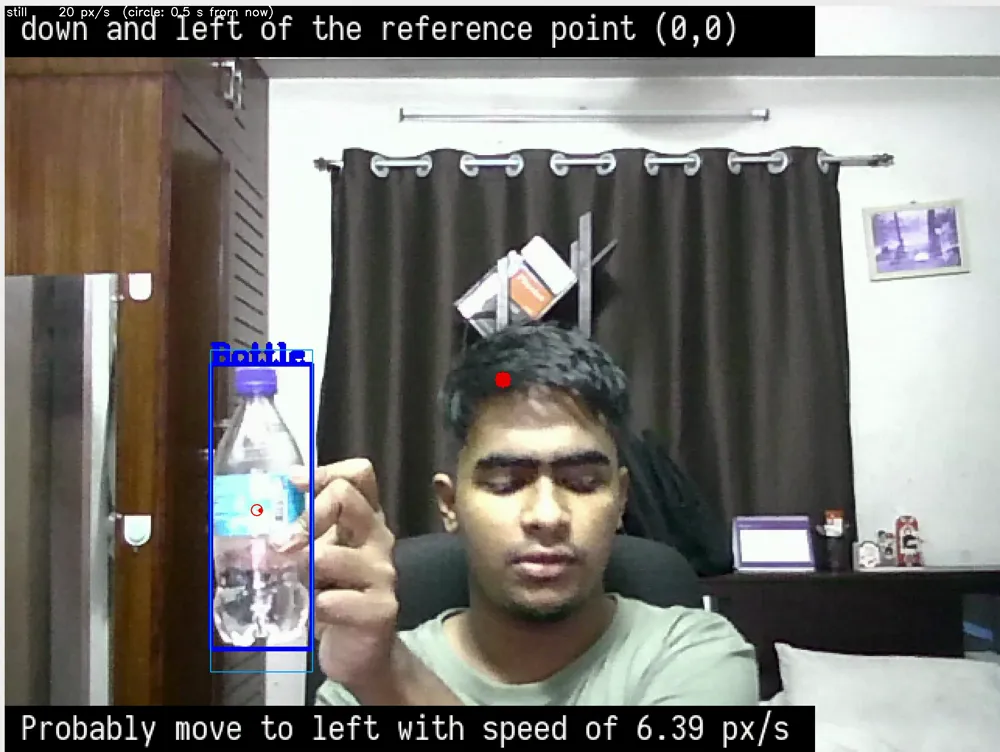
On the 2024 recording its verdict changes on 16 % of moving frames, against 19 % before. Better, not done: each re-seed makes the box jump a little, and the filter reads every jump as motion. The real fix is to feed detections into the filter as measurements instead of resetting the tracker. It’s filed as an issue, not hidden in the README.
What I take from it
Filtering is the cheap win: close in, the Kalman filter cuts error by about 40 % over raw differencing, for a handful of multiplies per frame.
Better filtering can’t predict a hand. Only a better model of the thing moving can.
Past about 150 ms every constant-velocity model is wrong in the same way. That’s the whole game in robotics: an underwater vehicle tracking a gate doesn’t need to predict a hand, it needs to predict itself, and its own dynamics are knowable. That’s where this line of thinking went next: the frame-age problem, and the lock ladder.