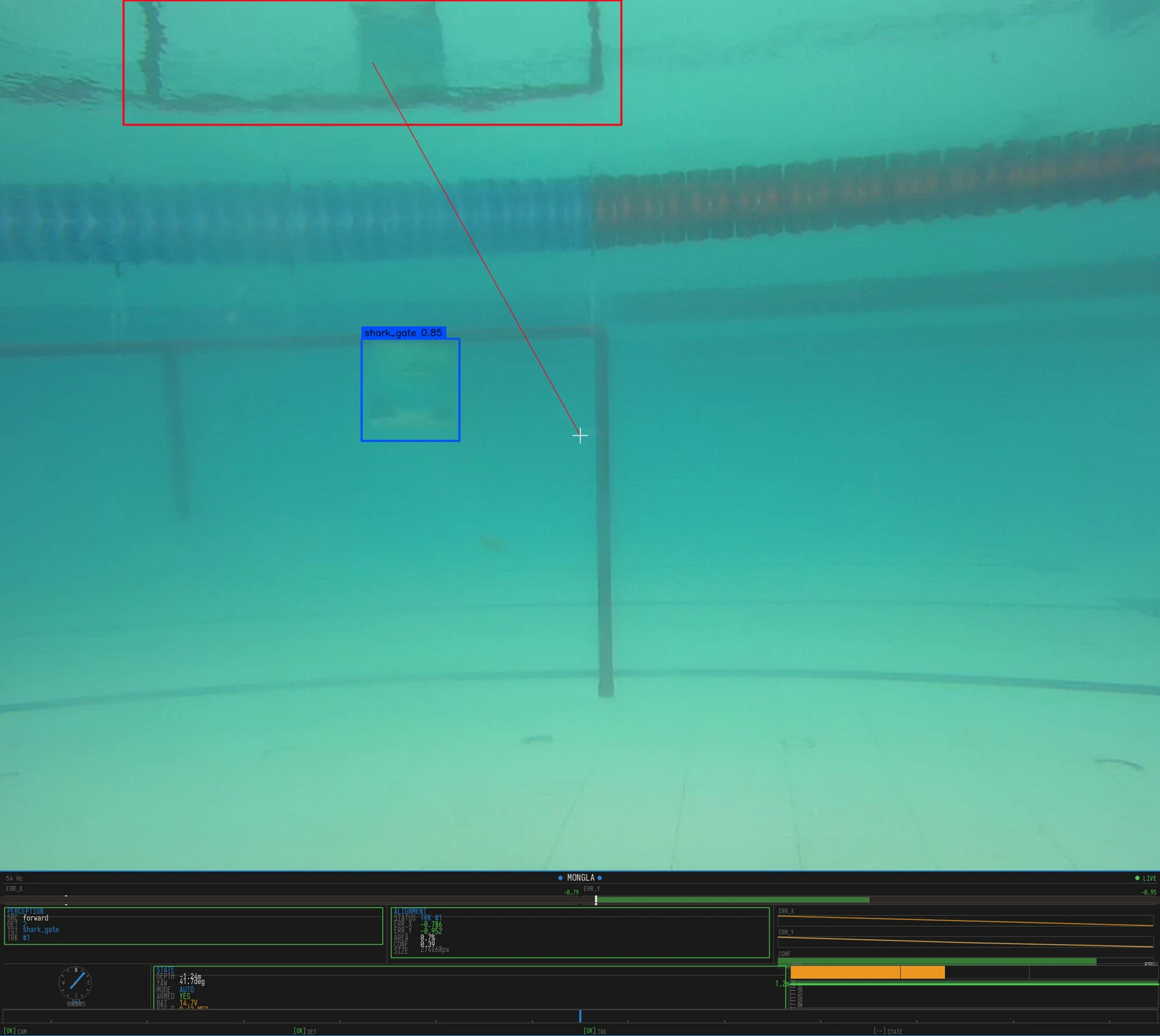
The plan named a canary: one test column, torpedo_1, which INT8 must not push below 15 inliers. It sounded sensible. It was also wrong, and following it would have killed a working feature.
The test kept the downstream path fixed: the same NumPy post-processing, USAC_MAGSAC geometric fitting and fifteen-inlier acceptance rule. Each clip supplied a reference at 40% of its duration and queries one, three, five and eight seconds later. Both arms ran on the Pi; the feature backbone changed from float32 on the CPU to INT8 on the Hailo-8. This was a recorded-input comparison, not a new underwater run.
An inlier is a proposed correspondence that agrees with the fitted geometry under the estimator’s criterion. It is not automatically a correctly identified physical target. The acceptance rule asks a narrower operational question: does this pair provide enough geometric support for the next stage to consider it?
Five clips and four query offsets made twenty paired comparisons. The clip-level outcomes were unchanged: 4/4, 3/4, 4/4, 4/4 and 4/4. Keeping the pairs matters. Two implementations can have the same total number of passes while failing on entirely different inputs.
- −7.7 %
- median inliers lost to INT8 across 20 columns
- 5 of 20
- paired columns with higher INT8 inlier counts; not a demonstrated accuracy gain
- 0
- passing columns pushed under the bar
What quantisation can change
Reducing numerical precision changes the feature values available to the matcher. That can alter nearest-neighbour choices and which correspondences reach the robust estimator. Geometric fitting then introduces another decision boundary. The final count is therefore not a monotonic measure of how much numerical precision was removed: a changed descriptor can lose a match, gain a different match, or change the fit that determines which matches count as inliers.
The ledger attributes the upward counts to MAGSAC variation. The important limit is that this table does not isolate that cause. Repeated fits and a controlled accounting of feature and estimator changes would be needed to attribute each difference. Neither five increases nor a negative median establishes a universal effect of INT8.
Read the tell
Nineteen of twenty columns cleared 15 inliers on CPU. The same nineteen cleared it on the chip. And the canary, torpedo_1, read 12 on INT8, which looked like a quantisation failure until you read the CPU column next to it.
A regression is a change relative to the baseline—not merely a result below the line.
Calling this pair’s INT8 result a new failure would have condemned a usable path for a case the CPU had already failed. Define a passing-to-failing transition as CPU ≥ 15 together with INT8 < 15. None of the twenty pairs made that transition. That is a stronger comparison than noticing that one number is small, and a much narrower claim than saying the two models are equivalent.
The margin still matters
A threshold turns a continuous-looking count into a discrete decision. Losing one inlier can matter when the baseline sits on the boundary; losing many may not change a decision with a large margin. For that reason I would keep the paired counts as well as the pass flags. A table of flags alone conceals how close a future input could come to changing the outcome.
The positive result is useful: this stock-weight accelerator path retained the recorded acceptance decisions. It does not establish performance on new clips, different water, another detector configuration or newly fine-tuned weights. The source explicitly requires a fresh quantisation comparison for new weights. It also reports timing on the detect path, not an end-to-end mission improvement.
Beyond an inlier count
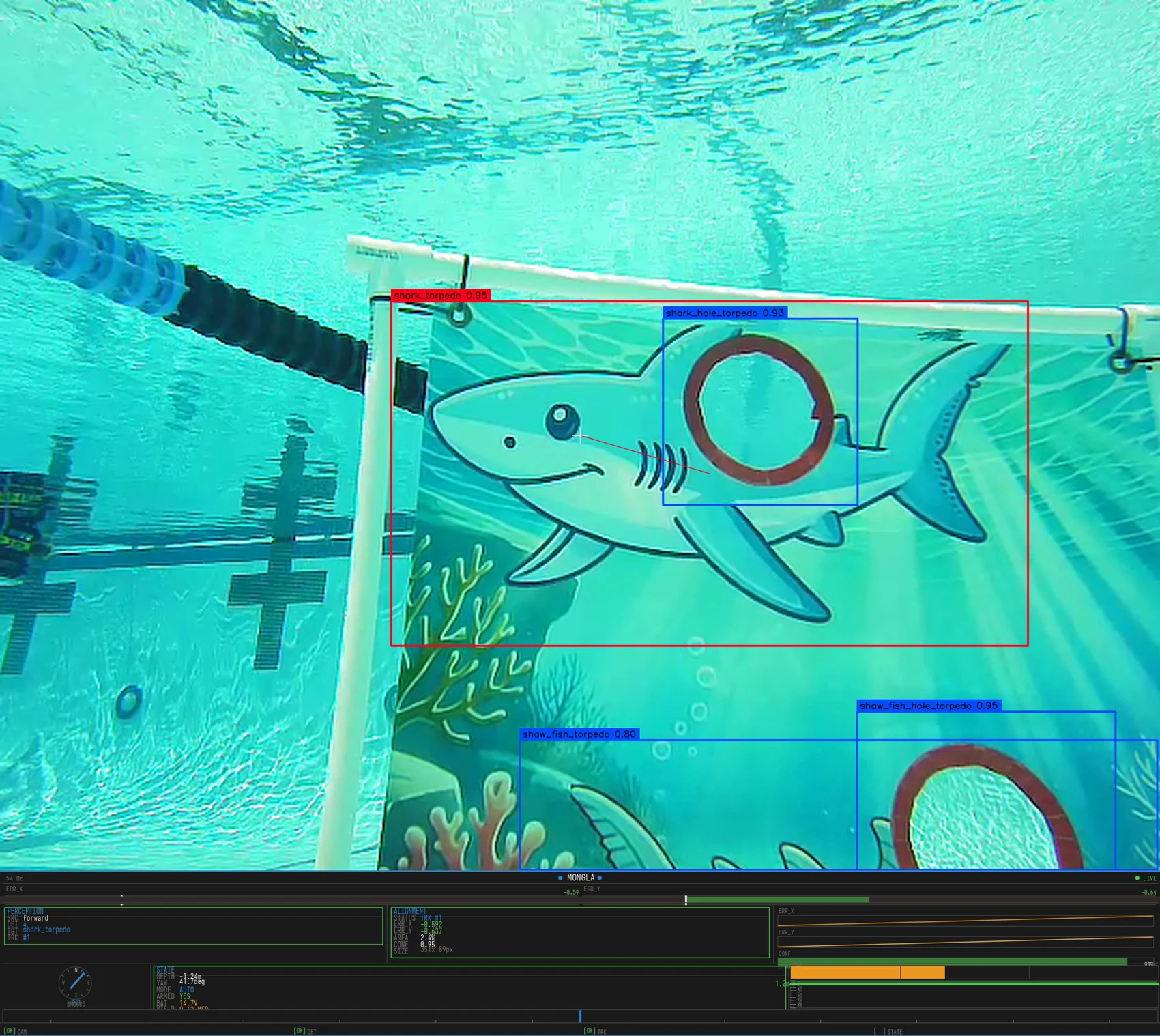
MAGSAC++ has a quality function and sampling procedure designed for robust geometric estimation. Our external fifteen-inlier rule is still an application decision, not a calibrated probability that a target is correct. Repeated structure can support a convincing wrong fit. The next question is whether a known transformation or independently checked correspondence supports the geometry—not whether the overlay looks confident.
That distinction connects this case to measuring against constructed truth and the fine-tune whose scorer hid its result. The useful habit is to preserve the baseline, the paired inputs and the decision being tested. Otherwise a canary can be blamed for dying before the experiment began.