The question was supposed to be simple: does when a landmark fix arrives matter? My previous commit argued for getting one early. The next experiment did not support that advice for the case I was actually running.
This was a controlled simulation, not a vehicle finding a landmark underwater. The harness drove a model for 60 seconds, started the estimator with one metre of horizontal position error, and supplied healthy optical-flow velocity, depth and heading observations. A synthetic position fix arrived at 2 Hz while its visibility window was open.
A two-second window beginning at 0, 20 or 55 seconds ended at 0.202, 0.270 and 0.276 m of horizontal error respectively. Timing changed the result, but did not produce the dramatic early-versus-late distinction I had predicted. All three stayed below 0.28 m in this run.
Why a late fix could still help
Velocity is information about how position changes, not an absolute horizontal position measurement. A vehicle can integrate its motion accurately while retaining the offset it started with. In this healthy-flow case, the launch error largely remained rather than growing into an uncontrolled drift.
An absolute landmark fix observes something the velocity aid cannot: where the trajectory sits in the chosen world frame. If the offset is still there when the fix arrives, a late correction can still remove it. This explains the experiment without making a general claim that fix timing never matters.
It also depends on the landmark being placed in a known frame. Recognising a prop is not itself a position fix; the geometry, calibration and landmark location have to supply that observation first.
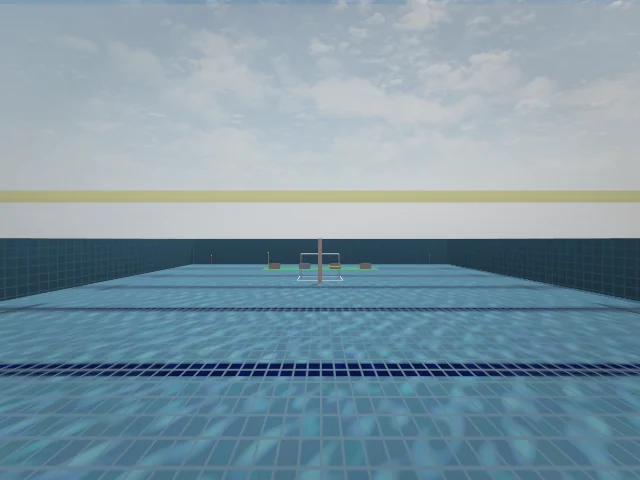
More observations, with the same healthy aiding
The archived final errors were:
| Fix window at 2 Hz | Position-fix updates | Final horizontal error |
|---|---|---|
| 0.5 seconds | 1 | 0.383 m |
| 5 seconds | 10 | 0.293 m |
| 20 seconds | 40 | 0.139 m |
| Continuous over 60 seconds | 120 | 0.055 m |
These are results from the pinned harness revision, not a fresh hardware run. More accepted information helped this configuration. The one-fix result already removed a substantial part of the one-metre launch error; the longer sequence improved it further.
The original report described the decline as roughly a square-root law. That is a useful theoretical comparison, not a fitted or validated law from these four points. For independent, unbiased observations of a fixed quantity with equal variance, averaging N samples reduces the standard deviation as σ / √N. Here the estimator is dynamic, its updates are weighted and gated, and the observations interact with the rest of the state. Correlated landmark errors or a shared calibration bias would not disappear just because more fixes arrived.
For example, anchoring a pure square-root curve at 0.383 m predicts about 0.121 m after ten observations; the reported value is 0.293 m. I keep the measured trend, not an assertion that the points prove the formula.
The more revealing control: trust the fix more
The same investigation tested a different operating condition: a 30-second run with one metre of initial error and continuous position fixes, comparing healthy velocity aiding with that aid absent. It changed the stated position-fix standard deviation:
| Fix standard deviation | Final error with flow | Final error without flow |
|---|---|---|
| 0.50 m | 0.1030 m | 183.3 m |
| 0.01 m | 0.0038 m | 564.5 m |
With flow present, the tighter observation helped. Without it, greater trust amplified the failure. This was much more informative than a single good run: the same observation could improve one operating regime and damage another.
In this right-invariant filter, the world-position update included an attitude-coupling term proportional to the skew matrix of the estimated position. A larger update gain could therefore inject a larger attitude correction. The state correction also rotated velocity; without the velocity observation constraining it, position error grew and increased the coupling again. Reducing measurement noise did not repair that observation model.
That does not mean accurate measurements are inherently dangerous, or that depth and heading should always be disabled when flow disappears. It identifies a failure in this implementation and configuration. A mitigation needs to be checked across dropout lengths and recovery, not inferred from the worst row alone.
Two claims I had to take back
The preceding commit had called landmark fixes a 508-fold rescue of the no-flow failure. That result relied on starting the estimator at exactly the true position. Once the harness supplied the initial error the estimator’s uncertainty allowed, the apparent cure did not generalise. At nonzero launch errors, position fixes did not reliably rescue that regime.
The timing claim also changed: the earlier text said an early fix was worth much more than frequent fixes. Both commits are from 23 September 2026, minutes apart, not two independent campaigns. Extending the harness changed the conclusion; it did not improve the filter algorithm between the two reports.
I would rather keep the experiment that changed the advice than quietly leave only the advice that survived.
Where the result stops
The plant’s drag was estimated, and this harness omitted currents, vibration and thermal drift. Sensor noise was configured, not identified from this particular physical campaign. Its default used one deterministic seed, and enabling additional measurements consumed more draws from the shared random generator. These are not repeated trials with every other sensor’s noise sequence held identical.
So I use the results to examine mechanisms and choose stronger tests. I would not use 0.055 m as a promised navigation accuracy, treat 2 Hz of synthetic fixes as achieved camera resection, or plan a real mission as though landmark timing and viewpoint never matter. A moving camera, growing flow-scale error and correlated fixes can change all three conclusions.
Start with constructing a known truth for the estimator. For the later measurement problem that this idealised harness does not settle, read low-cost VIO and the DVL question.