A bottom-lock Doppler velocity log reads speed relative to the seabed from acoustic frequency shifts. It provides a velocity reference where GPS cannot reach—not an absolute position fix. Mongla’s low-cost design does not include one.
What it does have is a camera pointed at the floor. When the vehicle moves, the floor slides across the image. The question is how to turn pixels per second into metres per second.
One ratio
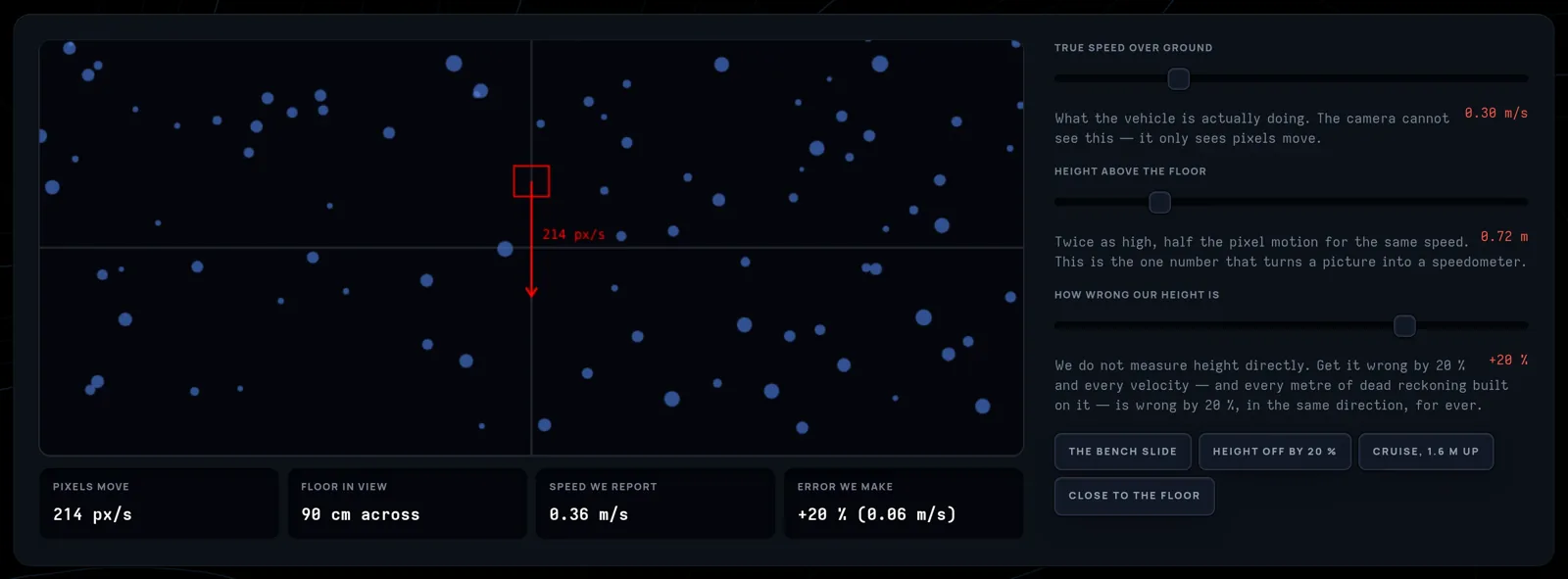
A floor feature directly below the camera, at height h, moving at speed v, slides across the sensor at v · f / h pixels per second, where f is the focal length in pixels. Turn it around and pixel motion is a speed, as long as you know h.
That’s the scale dependence the simple model isolates: with fixed calibration and a flat floor, multiplying the believed height by a factor multiplies the reported horizontal velocity by the same factor. Drift also depends on speed and elapsed time. Drag the numbers to explore that relationship; rotation, vertical motion and feature-tracking errors are outside this model:
Loading the diagram. It needs JavaScript; the text around it says the same thing in words.
Checking it against a tape
On 7 September 2026 the downward camera went on a bench rig at 0.72 m above the floor (by tape), and was slid 30 cm by hand along each axis.
| Record | Distance magnitude | Implied height |
|---|---|---|
| Lateral04:17:03 | 30.13 cm | 0.717 m |
| Forward04:18:18 | 31.09 cm | 0.695 m |
| Diagonal04:20:05 · -171.8° | 42.53 cm | Not comparable |
| Back04:21:43 | 31.04 cm | 0.696 m |
For the three nominally axial 30 cm trials—lateral, forward and back— the largest error in the integrated distance magnitude is 1.09 cm, or about 3.6%. That is a statement about these trials, not a general error bound on the velocity sensor or its two-dimensional trajectory.
The raw JSON also preserves a fourth record: magnitude 42.53 cm, angle −171.8°, and 31 fallback samples. The accompanying measurement ledger describes that run as a deliberately diagonal diagnostic. Its JSON still contains the logger’s nominal truth_m: 0.3, so that field alone does not establish the actual diagonal travel distance. I do not include it in the three-axis summary or treat it as independently validated directional accuracy.
Direction needs a separate reference. The forward trial includes a 6.93 cm cross-axis component in the reported coordinate frame. The ledger attributes the angle to the hand path; without an independently tracked two-dimensional path, this experiment cannot separate operator direction from directional estimation error.
The implied-height column is calculated as assumed height × tape travel / measured distance. For fixed tracked image displacements under the linear projection used here, measured distance scales with assumed height, so that assumed height cancels algebraically: the column re-expresses the same image displacement using the known travel. Comparing it with the lens-to-floor tape measurement is a useful consistency check, not a second independent experiment.
A DVL’s velocity specification and a visual-odometry paper’s trajectory error are not the same statistic as maximum distance-magnitude error over three short hand slides. These trials were in air; the ledger describes the manual reference as roughly ±1 cm, without an independently calibrated motion rig. That uncertainty does not establish an upper bound on the algorithm’s error, because reference and estimation errors can reinforce or cancel. The linked turbid-water visual-odometry study is further reading, not a like-for-like benchmark won by this test.
Three bugs, one mistake
Before those numbers, the capture tool reported a correct sensor as short three times in a row. The live trace showed the slide tracked correctly each time; the capture threw the measurement away.
- The end-of-move check lived inside
if v.ok:. A move ends with the rig stopping, a stopped rig produces refusals, so the stillness that defines the end was exactly when the check was skipped. Traced 29.89 cm, logged nothing. - The capture started at first motion, dropping the slow start and stop. Traced 30.3 and 30.5 cm; scored 19.6, 26.3 and 21.6.
- Stillness was judged on instantaneous velocity, and a refused interval read as zero speed, so a burst of refusals mid-slide looked like stopping. Traced 24.9 and 30.0 cm; scored 12.1 and 8.5.
All three were the same mistake in different clothes: treating “I could not measure” as “it did not move.”
The fix that ended it wasn’t a better heuristic. It was a button. The operator knows when they stopped, and no window short enough to be responsive can tell a slow hand from a still rig.
What it still isn’t
Every number above was taken in air. Through water the focal length changes (measured: 741 px against 513.94 in air, a ratio of 1.44; see the flat port for why water changes it at all), and the rectified water path has produced no measured velocity yet. The project calls it verified as arithmetic, not as a sensor, and keeps that line in the ledger until a slide runs through it.
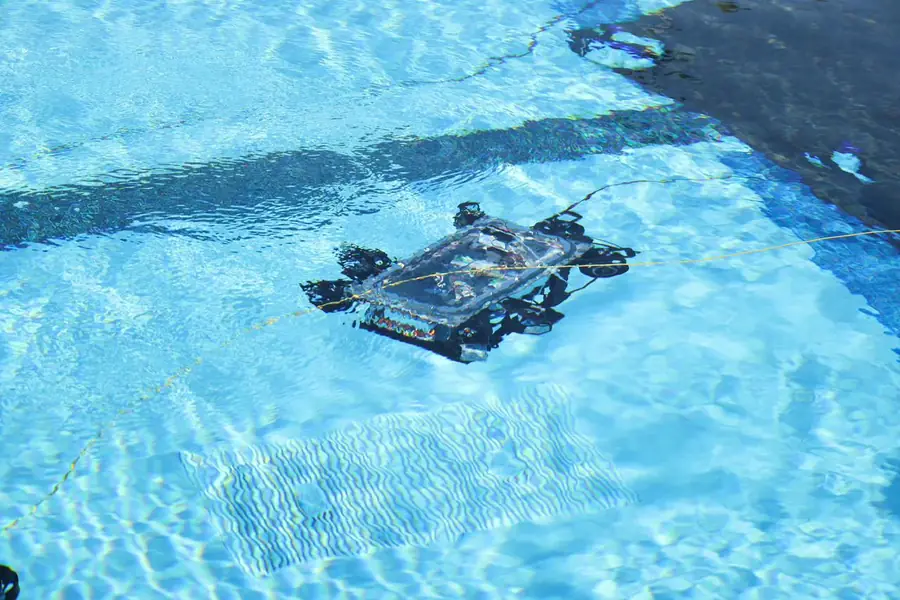
Next in the series, from the other end of the problem: why radio can’t help closes the loop on why this camera had to become a sensor at all. Or move on to Time, where every one of these measurements turns out to arrive late.