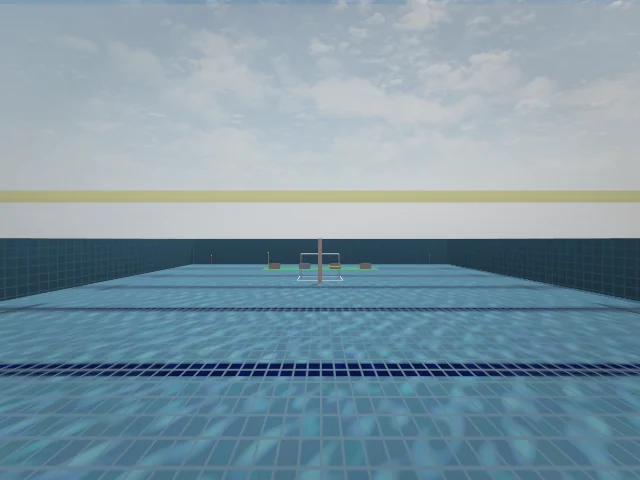
A camera calibrated in air does not automatically have the same field of view behind a flat underwater port. The image can remain sharp and centred while showing a smaller part of the world.
That matters to two different questions: how much a downward camera can see, and what a target’s apparent size says about its distance. The air calibration remains useful, but it is an input to the underwater model rather than a validation of it.
Rays bend at the glass
Light changes speed when it crosses from water into the air inside the housing, and a ray that crosses at an angle bends. Snell’s law says how much: nwater · sin θwater = sin θair, with n about 1.333 for water.
The sensor still accepts rays out to its own half-angle θair. Run that backwards and the widest ray it can catch from the water comes in at a smaller angle. The cone doesn’t move or blur; it shrinks. Drag the index from 1.000 (the lab) towards 1.333 (the pool) and watch it happen to Mongla’s two real cameras:
Loading the diagram. It needs JavaScript; the text around it says the same thing in words.
Calibration: pi_forward_1280x720.json (fx 851.2, 73.9° wide) and pi_downward_1280x720.json (fx 1027.9, 63.8° wide).
For the downward camera the model gives 63.8° in air and 46.7° in water. That is about a 27% reduction in angle, not a measured 27% loss of search coverage. At a fixed height above a parallel plane, footprint width scales with the tangent of the half-angle, not the angle itself. The actual course covered also depends on attitude, altitude and the usable image region. No underwater calibration is established by this calculation.
It’s worse than a smaller cone
If refraction only shrank the field of view, you could fix it with one number: compute an in-water focal length and use it everywhere. Mongla’s mission language did exactly that, and it was wrong in a more interesting way.
The angular relationship is nonlinear. On the forward camera at 640 px, the model’s effective focal length is about 567 px near the centre and 634 px near the edge. One pinhole focal length cannot represent the complete flat-port mapping. A ranging error can therefore depend on where the target appears, even when the camera and target dimensions are unchanged.
The audit placed a 1.5 m gate at a known model distance of 4.0 m. Its ray-traced examples returned:
| Model and target position | Returned range |
|---|---|
| Old shared focal, on axis | 5.15 m |
| Old shared focal, 1.2 m off axis | 4.59 m |
| Old shared focal, 2.2 m off axis | 3.33 m |
| Per-camera focal alone, on axis | 4.40 m |
Air calibration is an input to the underwater model, not its validation.
The September correction sent the metric-vision helpers through the same flat-port rectifier used by the lock and pose paths, then used the rectified camera matrix. That replaced a shared constant with a common per-pixel mapping and avoided maintaining two optical models that could disagree.
Test against rays, not another copy of the formula
The audit generated a known scene with a ray-traced flat port, projected target geometry and asked the ranging functions to recover it. Its recorded tests stayed within 1% for range_to and 0.5% for floor_range under that model, including off-axis cases. Removing the rectifier made those tests fail.
That is useful completed evidence: the correction answers the synthetic question it was designed to answer. Comparing the helper with another implementation of the same focal-length shortcut would only have established agreement between shortcuts.
Another defect sat beside refraction: floor_range assumed the principal point was the frame centre. The forward calibration placed it about 70 px away vertically at 720 p. Correcting a refractive model while ignoring that offset would still leave a bearing error. The camera matrix needs to travel with the image resolution and the rectified coordinate system.
What the model leaves out
The simple angular relation treats the air-side index as approximately one. Parallel glass interfaces preserve the net angular relationship, but finite port thickness and the distance between the lens and port also shift ray origins. A real flat-port camera is not generally a perfect single-viewpoint pinhole. The linked refractive-geometry paper explains why that distinction matters.
The regression validates software against its stated ray model, not the assembled housing against water. An in-water check needs independently measured target positions and dimensions, the actual port geometry, the capture mode and calibration, and observations across the image rather than only at its centre.
Ranging from apparent width adds more assumptions: a known physical target dimension, an appropriate pose model and a detection whose edges correspond to that dimension. A tilted gate or an incomplete box can defeat the simple width formula even after the ray direction is corrected. The optics fix removes one source of error; it does not certify every range estimate.
This is why I keep the theoretical cone, the synthetic regression and the missing physical calibration as different evidence. For the related ambiguity between image geometry and physical scale, continue with Matra. The interview bottle follows a different measurement chain from the same underwater years.