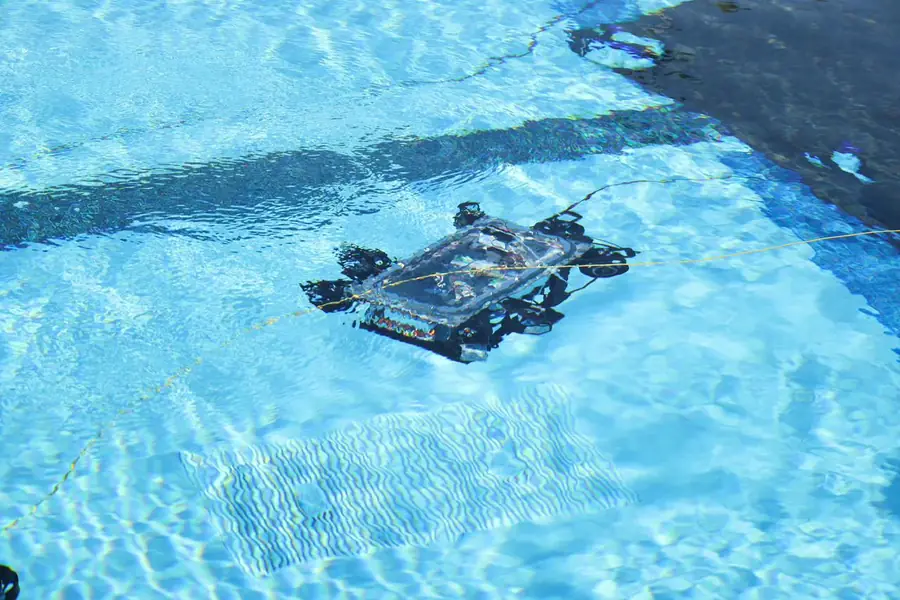
Start with the thing you lose. On land, a robot that doesn’t know where it is asks the sky: four satellites, a few nanoseconds of timing, and it knows its position to a few metres. If it gets confused, someone on a laptop can see its telemetry and take the controls.
Put that vehicle underwater and ordinary GPS, Wi-Fi and a convenient live control link can no longer be assumed. The electronics may still work; the propagation environment has changed. That is not a claim that every frequency and every specialised underwater link is impossible.
Why a conductor eats radio
In conductive salt water, an electric field drives currents through dissolved ions and dissipates energy. At microwave frequencies, water’s polarisation response also contributes dielectric loss. Some energy reflects at an interface; energy that enters the water is attenuated through the medium.
The explorable combines an illustrative single-Debye water model with assumed conductivities: 4 S/m for seawater and 0.01 S/m for the pool example. Its stated 25 °C inputs are εs = 78.4, ε∞ = 5.2 and τ = 8.27 ps. These are model inputs, not measurements of our venue. Frequency, salinity and temperature all matter.
Loading the diagram. It needs JavaScript; the text around it says the same thing in words.
Under those assumptions, the GPS-frequency example at 1.575 GHz loses roughly 8 dB per centimetre in seawater. The illustrative 38.5 dB gap between its surface power and tracking threshold is consumed in about five centimetres. Acquisition and tracking thresholds differ, and a real antenna, boundary and receiver add their own conditions; this is not a universal physical cutoff at exactly five centimetres.
Very-low-frequency systems can reach farther and specialised radio or magnetic links can work over constrained underwater distances. Their antennas, power, bandwidth and geometry do not make ordinary satellite positioning or laptop Wi-Fi a practical default for this small vehicle.
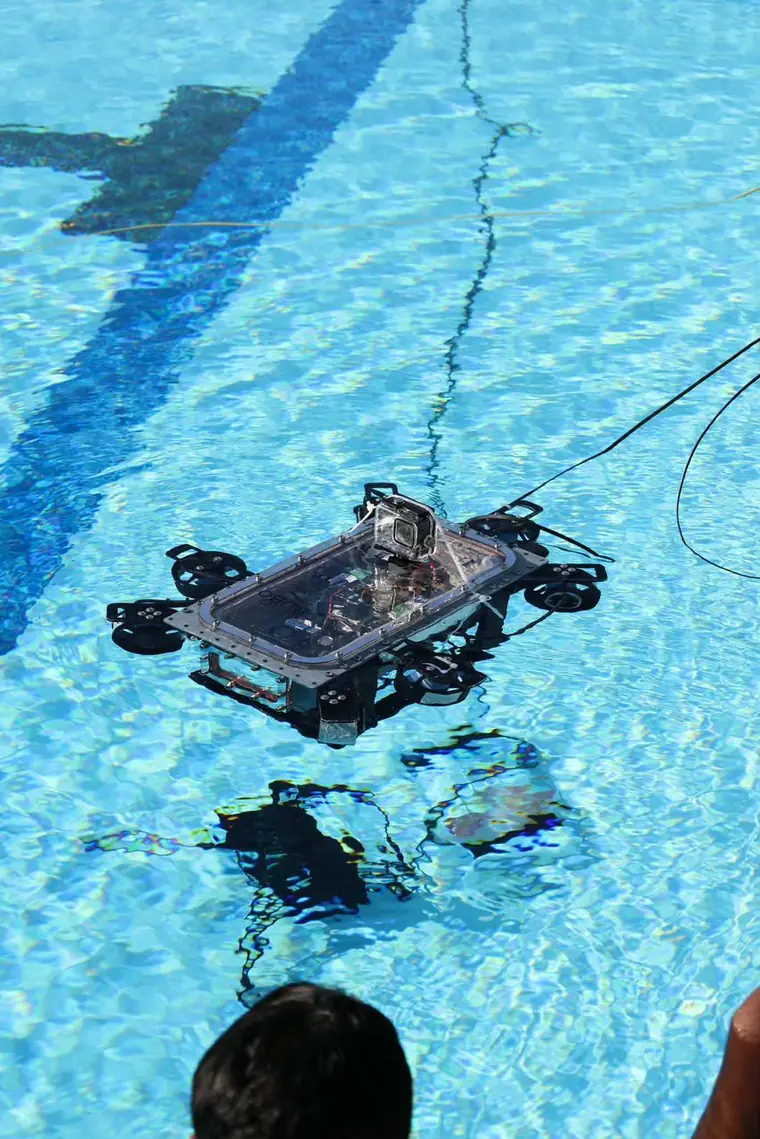
Fresh water is less conductive than the seawater example, but microwave dielectric loss still matters. A working tether is not evidence that radio works in the pool: it carries the link over a wire. A surface antenna or tether changes the system boundary, rather than disproving bulk underwater attenuation.
What it forces
For this untethered operating goal, the practical consequences are:
- Position has to come from the inside. An IMU integrates acceleration into velocity and velocity into position, and it drifts, because integrating noise accumulates it. So everything local that can be measured gets fused in to pull it back: depth from pressure, velocity from a camera pointed at the floor, heading from the attitude estimator, and occasional fixes from recognising something.
- The vehicle has to be right on its own. There’s no one to notice it’s confused, so it must notice itself, and say so in its logs.
- The reflexes can’t depend on the thinking. If the computer that runs the neural network stalls, the loop that holds depth must not. That’s why Mongla keeps its 500 Hz control loop on a separate board.
What does get through
Sound is one practical alternative. It travels at roughly 1,500 m/s in water, with the exact speed depending on conditions. Acoustic modems can carry telemetry and control, but propagation delay, multipath, available bandwidth and packet loss constrain the control strategy. They are not inherently limited to a few bytes or incapable of steering a vehicle.
Blue-green optical links can also work under suitable visibility and alignment, with range changing sharply with turbidity and geometry. Neither an acoustic modem nor a reliable optical communication link is established by this site’s propagation illustration.
For the small stack described here, those alternatives are engineering options, not a substitute for a missing tested link. The Ping360 work follows what can actually be extracted from an acoustic sensor’s supplied recordings.
The log is the conversation I can have after the vehicle comes back.
So the interesting engineering isn’t the happy path. It’s what the vehicle does when it can’t do something, with nobody on the radio to ask. On a well-built stack the answer is never a silent workaround that keeps the demo running. It’s a loud refusal and a written reason.
Next: Green, at depth, where the water stops being a wall for radio and becomes a filter for light.