A demo needs the thing to work once, in front of people, under conditions you chose. A competition run needs it to work the first time, under conditions the pool chose. Almost everything I’ve learned about reliability lives in that gap.
Competition experience supplies the question here; later source and bench audits supply the examples. They are different bodies of evidence. The Mongla examples below do not establish underwater mission reliability, and a successful shutdown message is not a measurement of a stopped actuator.
The first half of the gap is reachability: a module written, reviewed, merged and never reached. The fix is a decision made at write time. A module is either imported by something that runs, or it carries a written reason naming the consumer it’s waiting for. There’s no third state.
Injection-verify your guards
The second half is tests that can’t fail.
If a guard still passes when its protected behaviour is deliberately broken, it is not protecting that behaviour.
That changes how I read a green result. The useful question is not merely whether the test ran. It is whether the observation at the end would change if the claimed capability were absent. A test can faithfully check the wrong contract.
The clearest example is the September 2026 thruster-telemetry audit. Across two bench sessions, 958 recorded ESC_STATUS frames passed the decoder’s CRC check, and every reported RPM was zero. The board emitted all eight slots whether an ESC was present or not.
| Observation | What it establishes | What it does not establish |
|---|---|---|
| Frames arrive and pass CRC | A decodable transport path | A connected, working thruster |
| All eight RPM slots are present | The packet has the expected shape | Eight independent physical measurements |
| Every RPM value is zero | The wire reports zero | Whether a motor is absent, stopped or not being measured |
The old health test accepted a message-count-based success condition. The driver actually lacked the counter the reporter tried to read, so it returned an unknown verdict through an accidental default. Simply repairing the counter would have turned a correct-looking UNKNOWN into a false OK.
That is why a failing-before/passing-after demonstration has to target the meaning of the guard. The desired repair was not “make the health indicator green.” It was “base the verdict on evidence that distinguishes presence and fault from an empty stream of valid-looking messages.”
Some states cannot be distinguished by this observation
An absent ESC and an attached but stationary ESC can produce the same observed zero. No later threshold on that same zero can recover which physical state generated it. The missing information has to come from another observation or an explicit protocol signal.
This is a small observability problem, not a plea for a more complicated classifier. Keep unknown, healthy and faulted distinguishable. Whether an unknown state blocks a particular operation is a system-specific safety decision; a packet counter cannot make that decision on its own.
The abort path is a feature
Reliability also means the boring path works: stop, surface, disarm, kill. The emergency stop isn’t an accessory; it’s the one capability you must be able to prove on demand, because it’s the one you’ll need when everything else has already gone wrong.
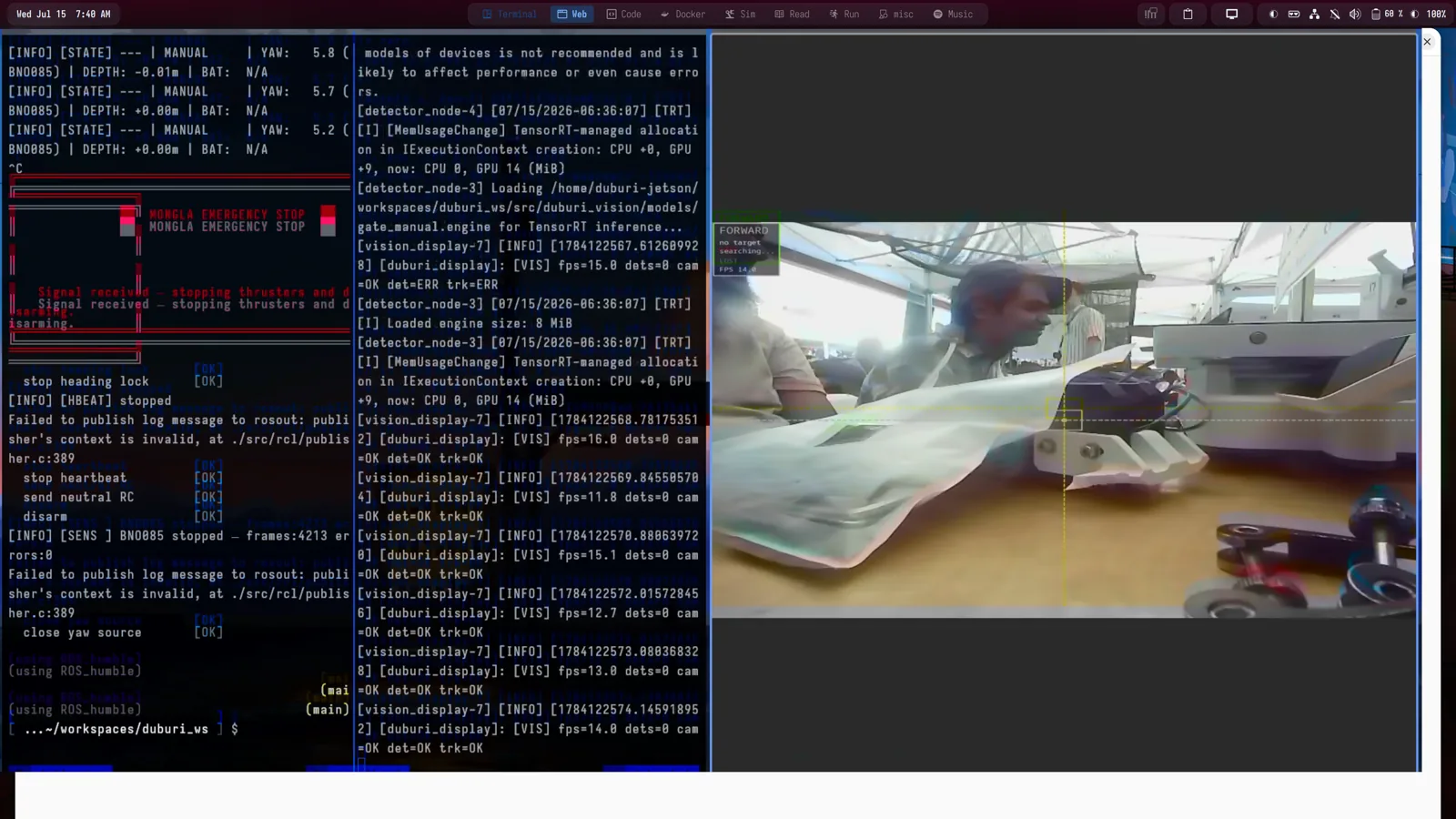
Stopping cleanly turned out to be its own saga: twice “verified on hardware”, twice wrong. That one is in killing a process tree.
There are several separate claims hidden inside the word stop. Did the operator request it? Did the supervising process receive it? Did child processes exit? Did the last command cease or become neutral? Did the physical system reach the safe state? A success at one boundary does not prove the next.
For software bring-up, I want the supported launcher and its actual descendants exercised together, including a child that does not respond as expected. For a physical safety claim, process exit is still insufficient: the actuator or its independent safety boundary has to provide the observation. These are acceptance questions, not new hardware tests claimed by this article.
Keep the unit, integration and physical claims apart
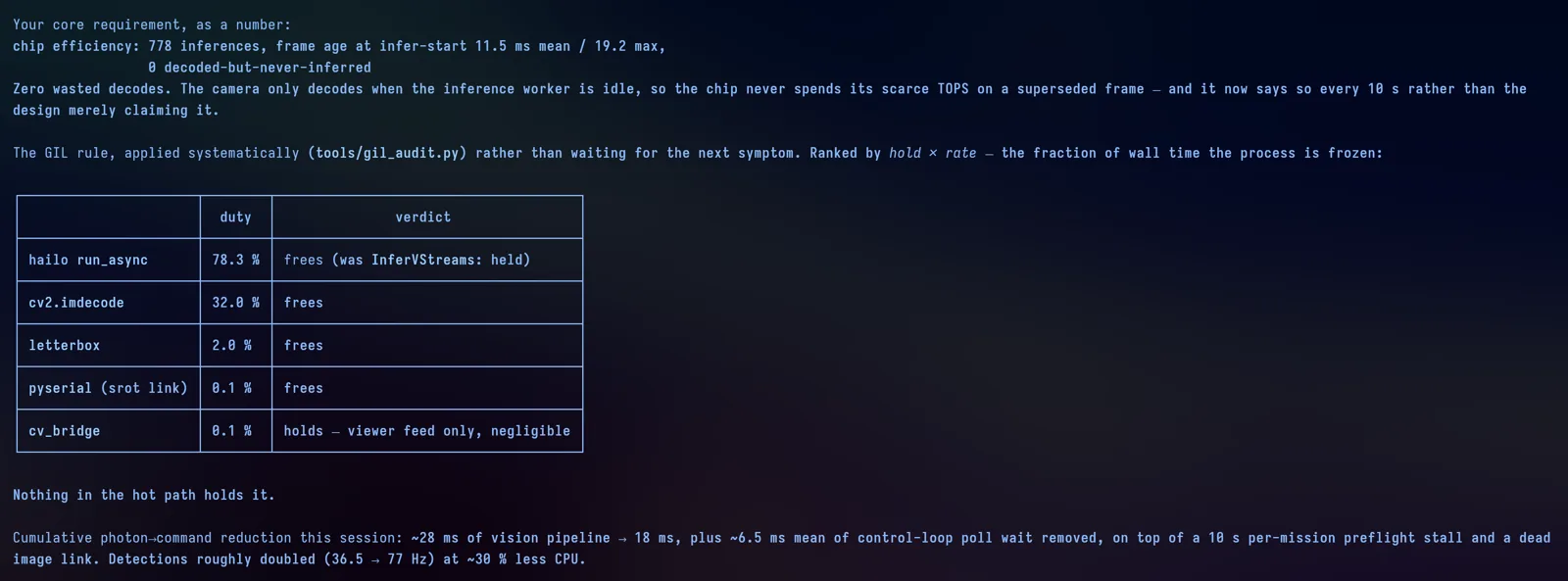
A unit test can check a numerical rule. A launch exercise can show that the documented command reaches it. A bench measurement can expose a device or process interaction that neither one models. A competition result adds real operating context, but it does not retroactively validate every later software revision.
I keep these layers together because they answer different questions. The reachability essay follows the launch graph; the process-tree investigation follows signal handling; the frame-age investigation separates a fast call from a recent observation. None is a substitute for the others.
The practical result is a less glamorous but more useful hand-off: which command was used, which version ran, what the independent observation showed, which failure was deliberately introduced, and what remains untested. That is the evidence I would want to inherit before trusting someone else’s machine, so it is the evidence I try to leave behind.