2026 →
Mongla
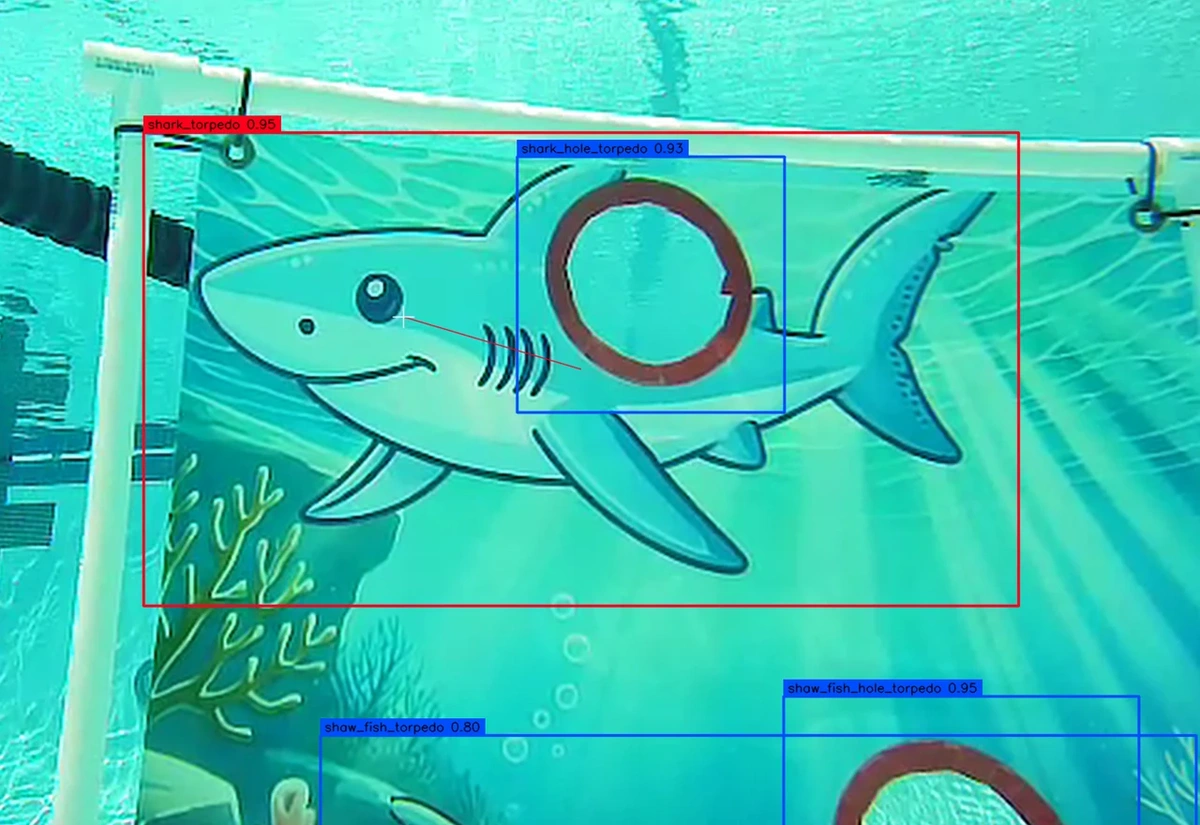
Bench: 30 + 30 Hz detectors and 3 Hz XFeat. Archived checkpoint: 4,742 tests, 0 dives.
Perception, estimation and mission logic share a computer, but the control loop cannot wait for whichever model or process happens to be busy. A capability also needs a launchable path, not merely a class somewhere in the source tree.
My part author (board and firmware: Rakibul Islam)
My contribution
Mongla separates the ROS 2 autonomy computer from the real-time control board through MAVLink. My work covers perception, estimation, mission execution, tooling and the evidence behind the claims. The SROT board and Hengla firmware are Rakibul Islam's work; Bondor is his ground station, to which I contributed.
Inspect the work
An independent autonomy stack for underwater vehicles. A 15 s repeated-frame bench on 19 November 2026 sustained two 30 Hz detector workers plus 3 Hz XFeat on one Hailo-8; this measures inference-call sharing, not live-camera accuracy or water validation.
- 500 Hzboard loop
- 30 + 30 Hztwo detector workers; repeated-frame bench
- 3 HzXFeat alongside; bench 2026-11-19
- 4,742tests at archived checkpoint
- 5thrusters, in the design
- 0water trials
Loading the diagram. It needs JavaScript; the text around it says the same thing in words.
The kill switch that said "clear"
KILL = 0 on the wire means thruster power is safely off-limits until someone clears it.
On link loss the firmware deliberately reports the kill as clear, labelled "display-only". It isn't display-only: it's re-emitted on MAVLink. So 0 meant either "power is live" or "nobody is telling us", and a killed hull armed and ran the mission.
Corrected in 2eb06f3. The full lesson
The acknowledgement that lies
Ask for 100 Hz and the board either does it or says DENIED.
50 Hz worked (50.17 Hz measured). 100 Hz came back ACCEPTED and ran at 50.00 Hz: silently clamped to its 20 ms floor. The ACK carries no information about what you'll actually get.
Corrected in a9dc790. The full lesson
A mailbox, not a queue
Drain the queue and take the last frame, as every reference recommends, and you're caught up.
A full V4L2 queue keeps the oldest frames and drops every new one. Draining hands you the least-old fossil: 348 ms stale instead of 396. A keep-up thread got 16.9 ms.
Corrected in 50d69a8. The full lesson
Five times the detections, retracted the next day
Contrast enhancement (CLAHE) recovers 5× the detections on blurry water.
Re-measured one variable at a time, it never helped: on the gate it destroyed about 95 % of detections. The original A/B had stacked a tracker fix and a confidence change into the same arm. Meanwhile a Bangladeshi pool's footage (Mirpur) showed cross-water transfer was fine: 97.5 % → 93.3 %.
Corrected in 04ba3ac, fd9757d. The full lesson
The calibration was wired to the wrong camera, both ways
The forward camera publishes the forward camera's calibration.
It published the downward camera's lens (fx 1027.87, 63.82°), named for the camera the system believed it was looking at before the USB rules were found swapped. Both halves were live and neither logged anything.
Corrected in 3d40aaf. The full lesson
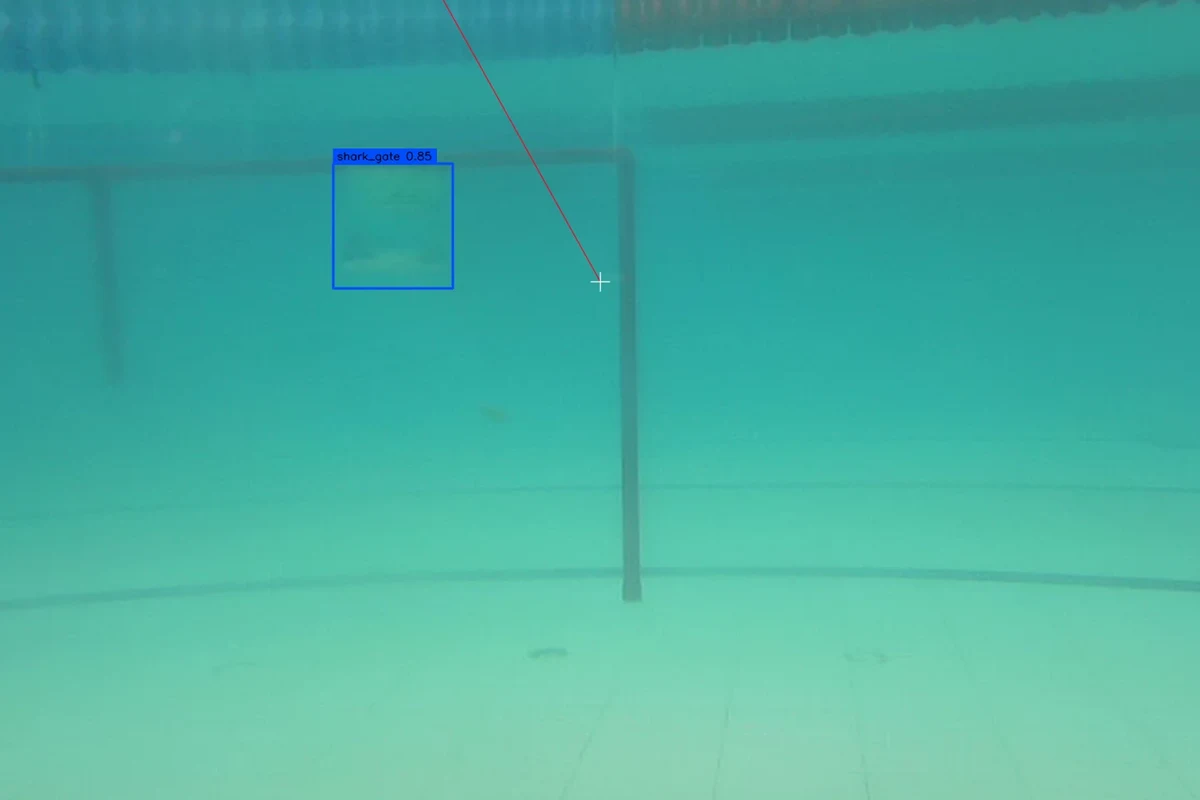
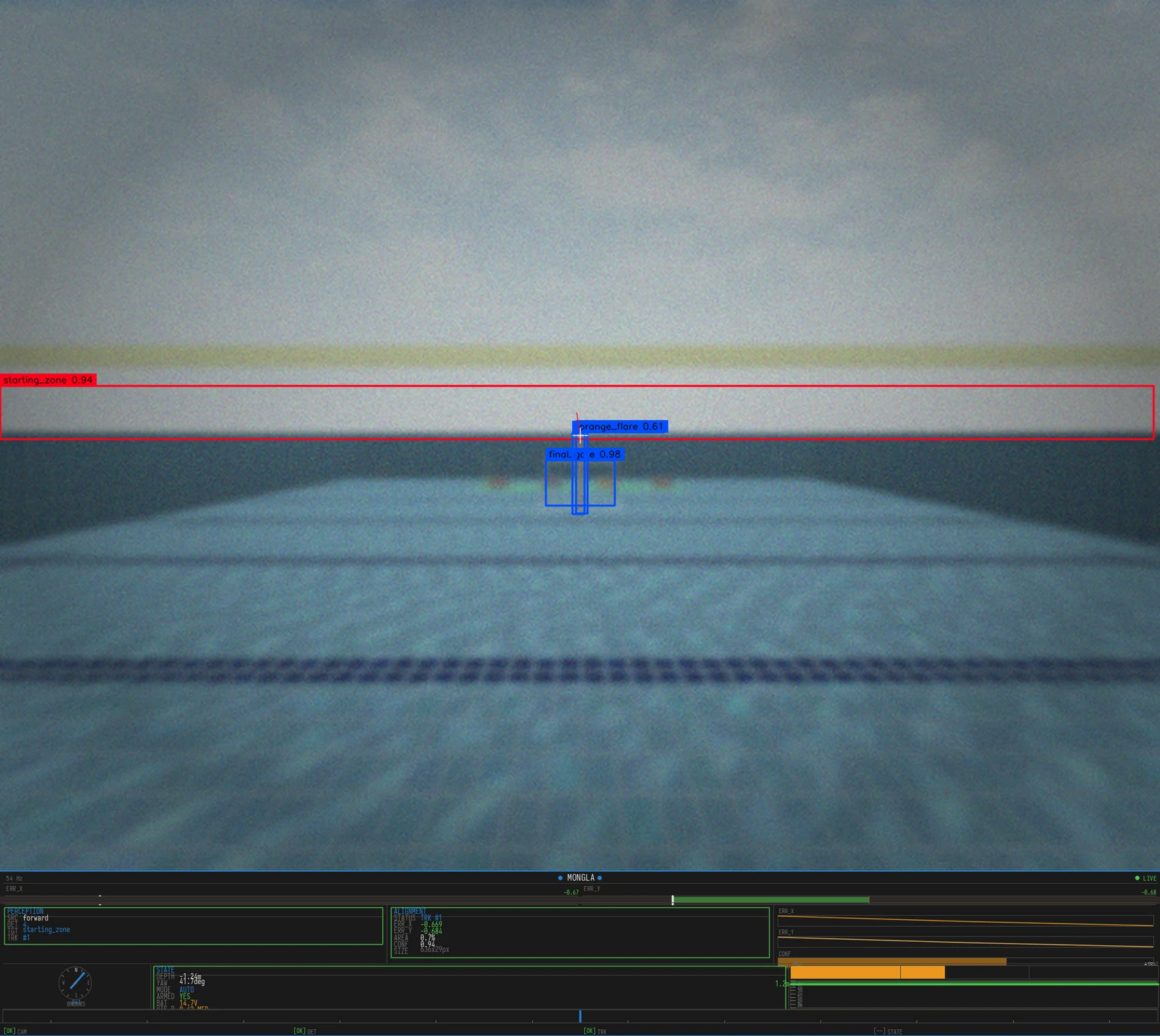
The blur was a 200 ms shutter
The detector struggles with this prop.
The camera sat in aperture-priority auto and chose a 200 ms exposure. At 5 ms with brightness raised, frames went from mean luma 26.6 to 135. And gain was inert: three settings gave byte-identical frames.
Corrected in b46b112. The full lesson
A detector with no model, reporting healthy
Everything said healthy, so the problem is downstream.
The accelerator device was still held by a previous process. The loader logged FATAL and returned; the detector stayed empty, and the inference loop skipped every frame, silently, forever.
Corrected in 82c4e70. The full lesson
The sign was wrong, not the size
The gains need re-tuning.
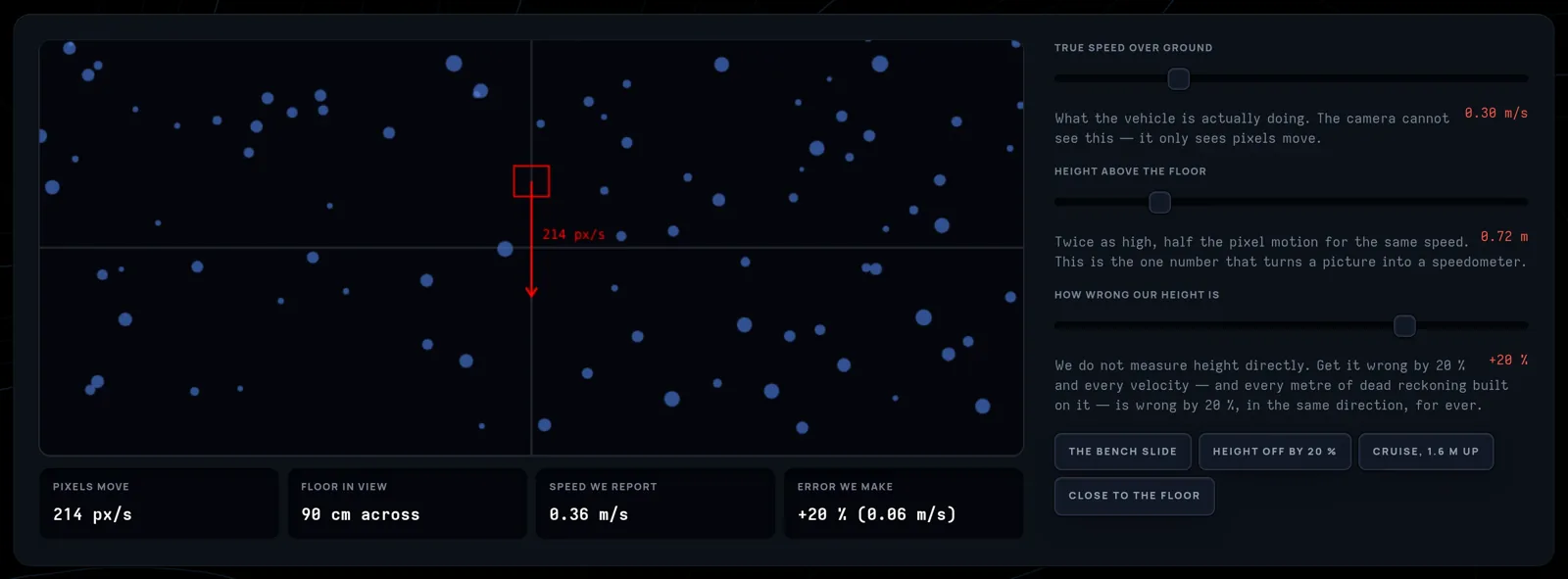
Re-derived on the hull: +1.058 and +0.830. Near unity, as a correct focal length predicts, and positive. Only the sign was wrong, and the shipped setting was doubly wrong (error ∝ |S + g| = 2.058).
Corrected in 07824b4, 355e1e3. The full lesson
Zero is not "unset"
The gyro is noisy at rest; the lever arm explains it; refused intervals lose travel.
My own test instrument published heading = 0.0 against the vehicle's ~180°, flipping the projection sign every interval so the travel cancelled. Fixed, it read 106.5 % through the shipped path.
Corrected in c175499, d1dd627. The full lesson
The guard that could not fail
The arming check verifies the depth loop has settled.
The check only runs while disarmed, when the loop never runs, so the value was always absent: it took the "not reported → pass" branch every single time while printing a reassuring line. Nothing failed in either repository.
Corrected in f27a747, 10b8e28. The full lesson
Age since arrival is not age since capture
The control loop's "frame age" is the age of the frame.
The stamp survived inference and was then overwritten with the time the message landed. The freshness decay, the coast ladder and the torpedo fire gate all measured age since arrival, and the whole 32.5 ms median pipeline delay was invisible to the loop that exists to react to it.
Corrected in 60f812a, d32baec. The full lesson
Two cameras, one accelerator, one turn each
The dual-camera path works; it's just slow to start.
It could never start: one device, one owner at a time. The same physics shows up on the K210 in Dristy, where the camera preview and the neural net share one lease.
Corrected in 35bf33b. The full lesson
Every commit
Each dot is one commit, placed by date. The red ones are fixes and retractions. Point at one to read it.